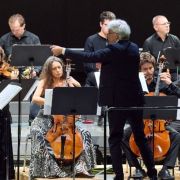
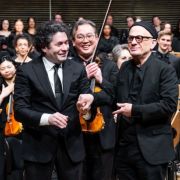
Musical establishments across the country have taken diverse approaches in celebrating – or observing – the 250th anniversary of the United States, some choices more obvious than others. As part of Carnegie Hall’s citywide United in Sound: America at 250 festival, the St Luke’s Chamber Ensemble joined clarinetist Kinan Azmeh for a rare evening presenting Azmeh’s own compositions. In the intimate space of the DiMenna Center’s Cary Hall, it felt less like a concert and more like an auditory omakase.

The evening opened with In the Element, the longest piece of the set and one that fully displayed Azmeh’s incredible gift for hearing and sharing the nuances of each instrument he writes for, revelling in the multi-vocality each has to offer. His own polyphonic production was breathtakingly compelling, creating the sense of distinct and meaningful conversation taking place between different voices within his instrument. But the ensemble managed to say a great deal of their own, with the ownership of musical arguments shifting and being shared between different musicians in an almost operatic sense. Over a half hour, the piece offered pockets of spiritual invitation into that which is beyond humans, and cheeky bits of sound that revelled in or played with what is between humans, including the use of the strings players’ own voices.


Up to the challenge of following such a strong opener was Two Syrian Imaginary Dances, performed by Margaret Kampmeier on piano and Azmeh on clarinet and also, in an unorthodox sense, on piano. The duet was replete with the joys and surprises found in actually watching live music being played, with the pleasure of a sound being no less enchanting when finding that it resulted from Azmeh’s playing his instrument directly into the strings of the piano, or setting the clarinet down to use the side of Kampmeier’s instrument as a percussion kit.

Though the program did not feature any new music, each piece was contextualized in a way that made the moment feel unique. Azmeh only played in three out of the four pieces for the evening, sitting back with the audience to let the string trio perform his Café Damas on their own before rejoining the group for The Fence, The Rooftop and the Distant Sea.
While it would be easy for some to write off Azmeh’s inclusion in the America at 250 Festival as a strong and direct political statement, the more interesting question is what his music has to say about his inclusion. Unabashedly referencing his life in, his memories of, and his playful imaginings about Syria, as well as Arab musical traditions throughout his work, Azmeh does not shy away from the inclusion of elements more akin to Western classical norms, nor from jazz, nor from references to his life in the US. His music succeeds in blending disparate styles and ideas into a cohesive whole without erasing their distinctness. What's more, the musicians clearly have a ton of fun realizing it – perhaps, one of the better aspirations of the American project.