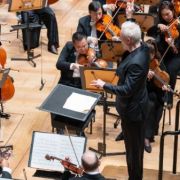
Although the Singapore Symphony Orchestra is multicultural in its composition of players, it remains the only predominantly ethnic Chinese Western professional symphony orchestra outside of China, Hong Kong and Taiwan. Just like the nation and its population, Singapore presents an interesting curiosity to people from the mainland. Its seven-city concert tour to China with Music Director Hannu Lintu is their first since 2011.

The first of two pre-tour concerts opened with the most performed 21st-century work by a Singapore composer, Wang Chenwei’s The Sisters’ Islands. This programmatic symphonic poem is based on a legend from the Indo-Malayan Riau archipelago (which Singapore is part of), and uses the pelog scale for its thematic material. Malayan musical idioms and dances present an idyllic soundscape, before the intrusion of dissonance, a pirate attack when the eponymous sisters Linah and Minah are assaulted and shanghaied. The merciful gods turn them into a pair of islands, the call of a conch shell and ocarina signalling a return to harmony in the high seas. This work, originally written for Chinese instruments and transcribed for Western orchestra, is now considered representative of Nanyang music, literally music from the south seas (Southeast Asia).


Mendelssohn’s Violin Concerto in E minor was the showcase for Singapore’s best-selling violinist Chloe Chua, who is presently pursuing undergraduate musical studies in Berlin. Finding celebrity at the age of eleven after sharing first prize at the Yehudi Menuhin competition in 2018, she has continued to mature musically, and this performance was a sign of this progress. Her tone is warm and generous, exhibiting excellent intonation, coupled with a winsome stage demeanour completely free of artifice. Early Romantic music prides itself on singing bel canto lines, which were brought to the fore in the opening and central movements. When the stops were pulled for the mercurial finale, Chua delivered without reservation.

Mahler’s Symphony no. 1 in D major, also known as the Titan, completed the programme. Because of the Formula One Singapore Grand Prix, neither Esplanade nor Victoria Concert Hall were available for the concert, necessitating a shift westwards to National University of Singapore’s Cultural Centre and its cavernous 1700-seat auditorium. Not designed as a dedicated concert hall, its dry acoustics were not ideal, especially for unaccompanied woodwinds and brass. Thus the first movement’s evocation of dawn lacked mystery and atmosphere, despite the players best efforts, but once the strings sang out the Ging heut Morgen übers Feld theme from the Lieder eines fahrenden Gesellen, the ensemble began to settle.


The vigourous Ländler that followed was taken at a good whip, with the boisterous pastoral setting already well established. The droll canon with Frère Jacques in the minor key for the funeral procession was just as trenchant, but one only wished that the Klezmer episodes that followed had more swing. When Mahler proclaimed the “symphony must contain everything”, he also meant vulgarity being among the attributes. It was no holds barred, however, for the finale’s “cry from the wounded heart” opening the tumultuous movement, and culminating with the eight French horns rising on their feet towards the end being a particularly stirring moment.