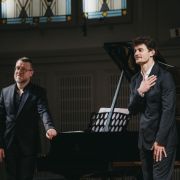
It is impossible to pigeonhole Michael Spyres. The American tenor not only sings a repertoire ranging from Mozart to Wagner, via Rossini and Donizetti, but also switches effortlessly to the baritone register as a baritenor. Spyres talks to Chanda VanderHart – the two long-time friends first met in a Lied class taught by Carolyn Hague at today's Music and Arts Private University of Vienna – about his upcoming Tristan debut at the Metropolitan Opera, his love for Vienna and Otto Schenk, and his Verdi ambitions. The only question is: Otello or Iago? Or both?

Tristan and Nemorino walk into a bar...
Chanda VanderHart: You're making your Tristan debut at the Metropolitan Opera this season while also singing Nemorino in Vienna a couple of months later – a startling combination for many.
Michael Spyres: Most people don't realize Wagner was very much a bel canto composer. Specific notations in his handwriting come from bel canto markings; he was influenced by his time in France. The Donizetti Klavierauszug to La favorite was made by Wagner. When you approach Wagner as a bel cantist rather than the German tradition before him, you realize, vocally, he was a bel cantist. All you have to do is remember bel canto technique and sing that, with Wagner's intents. The framework is a bel canto voice; you shouldn't completely change your technique.
Looking at the vocal line, there's actually not a huge difference between Nemorino and Tristan. That sounds crazy, but there really isn't. Nemorino is about style, not the weight of the instrument. You know this, as a pianist: you play the same tessitura with Schubert as with Chopin, but you're not changing your entire instrument – just style, interpretation and extended techniques. The only difference is that Tristan's tessitura is a bit lower and stays lower, sometimes right in the tenor passaggio. He wrote it more for a Baroque tenor, it's more baritone technique for Tristan.
Funnily enough, Tristan is one of the most natural things for my voice type – I'm this weird baritenor, and I feel more comfortable with the baritone. I had to learn to become a tenor over 15-20 years, and it still feels unnatural sometimes.
Anything you avoid before Tristan – or seek out before Donizetti?
It’s more about being conscious that my instrument is changing as I get older. Tristan feels natural, but I can't sing full-voice every day. Two hours of full projected sound starts to hurt your cords after a couple of days. Last month when I was really trying to test the waters and see what worked, I could sing through Tristan twice in a day and be completely fine, but the next day I needed to shut my mouth and not talk. Learning those physicalities, figuring out how much is too much, and of course, never pushing. You have to be clear that these are cute little vocal cords that can get inflamed.


Jack of all trades, master of some.
You're often described as a singer who resists easy categorization – neither by Fach nor by style. Do you experience that as freedom, or something you constantly have to defend?
It feels very natural to me, simply because I grew up in such a dichotomy, in a bizarre area of the world with extremism everywhere. My parents were very different: my father had an extremely militaristic childhood, but my mother was raised like a true gypsy, never knowing where her next meal or house would be. That's all intrinsic to who I am.
When people say, “We can't categorize you!” I say: that's the entire point of being an artist, right? It’s pushing boundaries within yourself and within the audience to be able to see where the edges are; where the precipice of art is. To me, that's our duty as artists. I believe in getting really good at everything that you do, but becoming an expert in just one little thing is boring to me. I'd much rather be a jack of all trades and master of none – or master of some.
Looking at your repertoire – Rossini, Berlioz, French grand opéra, Mozart, now Wagner – is there a through-line that binds them?
Absolutely. For me, anything I consider devoting my time to has to be historically significant; there has to be a reason to bring it back. There are tens of thousands of operatic possibilities. Sometimes you have to say no, this isn't worth my time – even though you feel terrible and want to bring everything back.
I think that comes from my parents being educators for over 40 years. Our job as artists isn't only to explore – it's to explore with the audience, show and teach them, have them possibly teach us. I'm not a musicologist, but I love show-and-tell. The through-line is finding the history of musicology, how it was formed over the last 200 years in popular opera. You can see the schooling: Mozart changed everything. Then Rossini. Then they invented French grand opéra, melding the European experience between them. Study both and you see the subcategories that split off.
Many singers think in terms of career branding – what a role “says” about them. Your choices feel more like curating an argument across centuries.
I've never enjoyed being the vapid romantic lead, that's why I don't really go in for Puccini. With a lot of verismo, many characters become chess pieces in a grand scheme I don't feel connected to as an actor. I like the freedom to have some say in what my character would do.
But honestly my career has always been: “Hey, do you want to do this?” And me saying, “I have no idea. Let's try it and see.” I've been offered many roles where I think: I would love to, but I don't want to only be known as this freak of nature.
Keeper of the flame.
You appear in several productions associated with Otto Schenk at the Wiener Staatsoper – L'elisir d'amore, Rosenkavalier and Fidelio. What does it feel like to work inside productions that carry such historical weight, such a legacy?
It's the greatest honor. Vienna means so much to me. In my formative years, I went through all the places a performer can go – choirs, singing for tourists, Theater Akzent, Palais Auersperg. Now to be in the highest form of opera within these historical productions – it's a huge honor to be the keeper of a flame.
I'm one of the most progressive, forward-thinking people, but I also love and respect everything that makes our society what it is. That's why it's so fun to be part of living legendary productions like Otto Schenk. It's important for modern audiences to see a more dated production, because there can be truly beautiful things by looking at the past.
In Rosenkavalier, the role of the Italian singer is very brief, but one with enormous impact. How do you approach a role like that so it feels dramatically necessary rather than just decorative?
It's Strauss basically making fun of great Italian singers – and I know because I spent five to seven years singing mostly in Italy! Some just show up like, “Who's going to teach me my role? Do we have to rehearse? I'm really hungry and there's a good sale at the market.” You rehearse for weeks, they give you nothing – then on stage, you're like, “My god, you're amazing! How did that happen?” Knowing that backstory and coming on as this prototypical Italian singer, putting all that into a small role – it's really fun.

You were one of the last Florestans in the old Otto Schenk Fidelio staging – the last one?
Yeah, the last one. Knowing the greats who did it in the last 55 years was a bit harrowing. But it was interesting to me because we have these ideas of our heroes in certain roles, so knowing they cast me made me feel that I've reached a place I didn't know I had, which feels good.
From a singer's perspective: what kind of direction – traditional or radically rethought – actually brings out your best work? And how quickly can you sense whether a production will function for you vocally and dramatically?


You know a lot when they give the presentation. Then the first couple days with the director – if they're willing to take your physicality and approach, or if they're very strict, “Nope, has to be like this.” I've been fortunate to only be in a few productions I didn't believe in – most while under contract in Berlin; you just grin and bear it. But for the last 15 years, I've been that weird singer around whom productions are built. They see some idea and go, “Michael could do that weird thing!” So productions are usually presented with me in mind, which is bizarre.
Vienna.
Vienna has been more than just a guest stop – it's been part of your formative musical life. Looking back now, what did studying and living here give you that still shapes your work today?
To be honest, it's what made me the singer I am. It sounds odd because it was only five years that I lived intensively in Vienna. I learned German there of course, but my schooling was really in the Arnold Schoenberg Choir, being within the entire milieu of what music means to Vienna – the intrinsic nature of it. You just feel it everywhere. It satiates you whether you like it or not.
I'd always heard of Vienna and knew the history. But when you're there among it, you see how much it truly influenced and created the society Vienna is today. Music is everywhere – there's more opera every single night in Vienna than any other city now.
I can't really separate who I am from what Vienna is. The schooling I had in those years – learning the Mozartian school, Schubertian Lieder – was so influential to everything I do. It gave me a strong grounding to go into basically everything.
I think of my Staatsoper recital at the end of April as a love letter to Vienna – thank you for all the beautiful music. I wouldn't have my life without Vienna. You and I, and so many, we are so enriched by this Zeitgeist within that city. So that's the idea: giving back to what we've been given – great lives – just because of a weird phenomenon that happened to touch all of us.
Coda: Legacy and looking forward.
Vienna audiences are famously attentive to tradition. Is there a Viennese operatic habit you cherish – and one you think they could let go of?
I love the tradition. Vienna is one of the only places in the Germanic world where people are still truly fanatic. After a performance, you sign autographs for sometimes an hour, talking, discussing the living, breathing organism of opera or Lieder. That doesn't happen in many places. You take it for granted there, then travel and come back and see the love – it's incredible.
The main thing I attribute that to is the history, the identity of Vienna, but also that opera is so affordable for everyone. That's how I saw opera as a poor student. People who go to the Staatsoper every day and stand truly love it. The ability to subsidize so that opera can be for anyone – cheaper than a movie, offers life-changing experience. That's what I love most.
What to let go? This purism, some elitists believing opera is only for certain people. It's funny because it’s so paradoxical – historically only a small percentage of the Viennese were upper class. The rest were like me, cleaning up horse poop. Not aristocrats. Some hide behind “I'm higher in society”, you see it in some Lieder and operatic crowds, hochnäsig! It’s fine to have taste, to have high standards, but don't act better than everybody else.
Looking ahead, which upcoming roles excite your curiosity most – not because they’re big, but because they ask new questions?
In a couple years, Verdi's Otello. I’m excited about really getting into Verdi, Ernani, Iago, Otello, exploring those characters. Verdi was the bridge between stage and realism, hearkening towards verismo, very stylized, but subject matters that could hit everyone. I find Iago fascinating. I'm also in talks about doing more Korngold. I love him, his incredible music, but the productions are so grandiose. You need an orchestra of 150, so that’s often cost-prohibitive.
This summer in Aix-en-Provence, Der Kaiser in Die Frau ohne Schatten. More Strauss. I love his subject matter. He got overshadowed as passé when he was taking over in Vienna, but the psychology in FroSch, the libretto, the composition – all mind-blowingly complex. He was as deep as Wagner. He didn't write his own libretto, but honestly, maybe Wagner could've used an editor… Dinner guests falling asleep in their soup while he talked about his own brilliance should have been a sign. I do love Strauss’ genius.