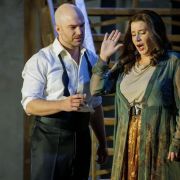
Days after the furore over the new Royal Opera Parsifal (triumph or disaster according to taste), Opera North dips a toe of its own in the murky pond of ‘director’s theatre’. Sadly, theirs is a concept from the shallow end that barely wets its ankles. To stage Tchaikovsky’s Eugene Onegin, an opera so steeped in the 19th-century Russia of its author Alexander Pushkin’s time, not to mention that of the composer himself, the Leeds-based company has turned to the Australian director Patrick Nolan, who has brought the tale forward to the late 20th century because this was “an interesting time in which to reimagine the story”.

Let’s waste little time on the production because, reimagined or not, it simply doesn’t work. The heart sinks at the opening image: two stacks of bleachers, as if opera hasn’t been sufficiently beset with grandstands in recent years, upon and between which the opening scenes occur. Why Tatyana writes her bedtime letter in such a location is a mystery known only to Nolan and his normally ingenious designer, Leslie Travers. The sports hall setting makes a mockery of the bucolic glory Tchaikovsky composed for his opening scene; while later, when Joshua Bloom’s superbly emotes his towering basso passion, one wonders how Prince Gremin managed to survive the Soviet cull of aristocratic dynasties that occurred decades earlier.

Faced with such slovenly plotting I fled to the score for solace, and under Music Director Garry Walker’s guidance it was outstanding. He and his Opera North musicians filled all the visual blanks with a blissful rendition of the score that sang in the idiomatic tones that even Chekhov and Gogol would have relished. The company’s resounding Chorus made rousing contributions, undeterred by a flatly staged Jets-and-Sharks inspired ‘Dance at the Gymnasium’ (originally Tatyana’s name-day ball) that seemed to revel in Perestroikan tackiness so that the rough-house eruption between Onegin and Lensky, far from smashing the evening’s courtliness and gentility, felt completely at home. If that was the idea, it missed the point.

Throughout the cast there was some exquisite solo work, performed in Russian and all the better for it, that ranged from the glorious pastoral duet between Madame Larina (Hannah Mason) and Filippyevna (Claire Pascoe) to a remarkably sleazy Monsieur Triquet, a role sung with unwonted seductiveness by tenor Florian Panzieri.
Mezzo-soprano Jingwen Cai as Olga was fiery and compelling as the unwitting catalyst for so much distress, while Casper Singh delved into Lensky’s mental state to create a vulnerable, unstable character upon whom modern psychology would surely hang an acronym. His was the performance of the evening, so once John Brancy’s Onegin had despatched him in a neat Russian Roulette spin on the pivotal duel, we both mourned him and missed him.

Brancy himself gave a convincing account of the paradox-ridden title character – timbre beautiful, frame of mind less so – and his Onegin underwent a credible evolution in his infatuation with Tatyana. Verity Wingate sang the latter role with passionate aplomb but was not well supported by her director. She never seemed at ease in the physicality of her character, especially in the Letter Scene which was one of several under-directed arias (Lensky’s showpiece aria was another) that received the stand-and-deliver treatment, face to the audience, with little or no dramatic context.