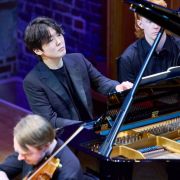
London’s EC1 was abuzz with young Koreans this weekend, and that can only ever mean one thing: Seong-Jin Cho is back in town. After a string of phenomenal concerto performances, his LSO Artist Portrait series is winding down, but not without a day devoted to the joys of chamber music at the newly-refurbished Jerwood Hall. Given carte blanche, Cho crafted two programmes of intelligence and generosity, with collaboration at their heart. Across the day, a unifying thread revealed itself – each work, in its own way, transcending the limits of its form.

The lunchtime concert opened with Donghoon Shin’s My Shadow (2021), a piece inspired by Robert Louis Stevenson’s eponymous poem. Where the fireworks of Shin’s Piano Concerto dazzled last year, this score operates under taut restraint. Tinted shards of melody, sloping clarinet lines and ghostly string harmonics conjured an atmosphere of half-light and ambiguity. Cho’s playing was chameleonic: sharp and agile one moment, shadowy and elusive the next. He never imposed on the texture, instead binding the episodes into a cohesive whole.
If Shin’s miniatures inhabit the shadows, Brahms’ Piano Quartet no. 1 in G minor strains towards symphonic breadth. Even within the confines of four players, Brahms seems determined to exceed the genre’s boundaries, as recognised by Schoenberg in his 1937 orchestration. Joined by LSO principals, Cho helped realise this expansive vision in a reading imbued with Romantic spirit. Though strings sometimes outweighed keyboard and the Intermezzo’s nervous tension felt a little subdued, any lack of intensity was forgiven in an Andante con moto that marched along with implacable heroism. Hungarian fervour ran through the Rondo alla Zingarese, exhibiting volatile and dynamic passagework. Even at lightning speeds, Cho’s awareness of his partners was pinpoint; he knew precisely when to surge forward and when to recede, ensuring the music, not the pianist, was the focal point.
The evening concert brought a marked shift in atmosphere. Reunited with his long-time friend and compatriot Sunwook Kim, Cho turned to the format of piano duets – an intimacy that demands both physical proximity and musical trust. From the first bars of Mozart’s seldom-played Sonata in F major, their deep artistic rapport was clear.
The opening movement was crisp and polished, its dynamic shading gorgeously nuanced. The Andante flowed in one serene arc, its long-breathed phrases shaped with perfectly judged rubato. Here, the advantages of four hands at one keyboard were unmistakable: contrapuntal exchanges flowed with conversational ease, and the blending of timbres created an orchestral richness that belied the modest forces. The finale’s rhythmic lilt was lightly tongue-in-cheek, with stylish embellishments to rival any of the concertos.

Cho and Kim then swapped positions for a selection of waltzes by Wolfgang Rihm – works that simultaneously inhabit and subvert their dance origins. Upon first hearing, they can sound jagged, even wilfully perverse; yet beneath the surface lies a sly pastiche of waltz traditions. The duo shaped each fragment into a self-contained world, allowing them to bleed seamlessly into one another. Lush harmonies were undercut by unsettling twists, evoking a distant ballroom glimpsed through fractured memory. Here again was that impulse to transcend form: the waltz turned on its side and viewed askew.
Schubert’s Fantasia in F minor provided the evening’s emotional core. Cho and Kim drew a sound of burnished depth, investing the music with immense weight and beauty. March passages were tinged with a bitter edge, while the luminous F sharp major theme offered an oasis of repose. But this was a bleak and desolate reading, building to terrifying extremes with slow, inexorable force. By this stage of an already demanding day, Cho might have been forgiven for showing signs of fatigue, yet none were visible: his focus remained razor-sharp, his touch responsive and alive.
Across both concerts, Cho reaffirmed his stature as one of the most searching and selfless musicians of his generation. His hallmark clarity, agility and intellectual poise were always present, but never for display; they served the music and his collaborators. By shaping a day around dialogue rather than ego, he revealed himself not only as an outstanding pianist but as a thoughtful curator, working with others to illuminate each work from within.