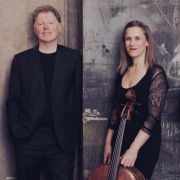
In this Ensemble 360 concert, given in the warm acoustic of Sheffield’s Upper Chapel, the focus was very much on colour and light, and the ways in which the apparently restricted palette of violin, cello and piano can be exploited to shimmer and dazzle to startling effect.

The concert contained a work new to Sheffield, Dani Howard’s Unravelled, a Music in the Round co-commission, which had been given its premiere by these same forces last year. Introducing it, pianist Tim Horton speculated that the title, having the word ‘Ravel’ embedded within it, signalled something of its sound world, and it was definitely the case that Howard’s writing revealed a similar crystalline clarity to Ravel’s own piano trio. The outer movements rippled with gently cascading piano figures, around which violin and cello wove closely synchronised patterns of imitation and echo. The central slow movement had a greater focus on stillness, but even here the scoring retained a pellucid quality, as though one were hearing light being diffracted through a prism. Howard is clearly a composer of vivid imagination with a sympathetic touch when it comes to instrumentation. This performance did her work proud.
The final work in the concert was also a piano trio... sort of. Sally Beamish’s rescoring of Debussy’s orchestral masterpiece La Mer, at the behest of Trio Apaches in 2013, is an altogether more daunting challenge. Beamish wisely ducked the impossible task of rendering Debussy’s entire score for three instruments, but even so the performers sometimes barely had room to breathe before the next wave of sound was upon them. It would be interesting to know what this version might sound like to someone who had never heard Debussy’s original, and whether it sounded like ‘a piano trio’, but unfortunately I am not that person. There were many times when I mentally rescored the performance as it was happening to imagine Debussy’s woodwind and brass writing, and occasionally the climaxes here sounded, paradoxically, denser than when played by a full orchestra. Still, this version made interesting and persuasive choices, often giving Debussy’s string-led themes to the piano, while woodwind melodies thrived on violin and cello. Just occasionally the effect was revelatory, as when Gemma Rosefield’s solo cello depicted the gruff churning of wind and waves at the opening of the work’s final movement. Throughout, the players inhabited the music with total commitment and exceptional virtuosity.
Alongside these two substantial compositions for piano trio the concert presented its audience with three duos. Nadia Boulanger’s Three Pieces for Cello and Piano is a work of apparent innocence and playful charm, and it was played by Rosefield and Horton with no attempt to make grander claims for it. The final movement fizzed with a kind of skittish intensity, but the first two movements made the stronger impression, with their song-like melodies and spare accompaniment. Boulanger could be artful – witness the canon embedded in the folksong-like second movement – but, while not being mere salon music, these pieces breathe that same air.
Horn player Naomi Atherton evidently picked the concert’s short straw, providing the metaphorical curtain raiser to each half of the event. Before the Debussy she played Saint-Saëns’ immaculately well-behaved Romance, but the concert opener, Schumann’s Adagio and Allegro, is a work of far greater substance, and its challenges, notably the long, sustained, high lines of the Adagio section, left her rather exposed at times, and it wasn’t until the vigorous ‘hunting horn’ energy of the Allegro section that she and Horton began to sound at their ease.