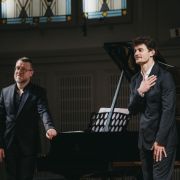
Jakub Józef Orliński’s recital with Michał Biel at the Wiener Konzerthaus was, in many respects, impossible not to admire. The countertenor is a phenomenon: a singer of extraordinary range, colouristic imagination and physical ease, seemingly untroubled by the ordinary human requirement to breathe. Biel, too, is clearly an agile and committed partner, and the rapport between the two Polish artists, developed also through their exploration of Polish song, was palpable. The evening’s programme was intelligently conceived, avoiding German Lied in favour of Handel and Purcell, Tadeusz Baird’s Four Love Sonnets, and a substantial group of songs by Mieczysław Karłowicz. And yet, for all its brilliance, the evening left me uneasy.

From the moment Orliński stepped onstage, it was clear that a large portion of the packed Mozart-Saal had come not merely to hear him but to adore him. The audience was vocally enthusiastic, quick to applaud, eager to record, and – in at least three cases I saw – willing to argue over using phones or not in the hall. That atmosphere mirrored something in the performance itself, namely a constant emphasis on effect. Orliński’s charisma is undeniable, and his showmanship is generous, but the recital often felt less like a Liederabend than a sequence of exquisitely lit miniatures, each one charged with feeling, gesture and immediate impact.
The most troubling moments came in Purcell. Sweeter than roses, What power art thou, If music be the food of love, and Oh, lead me to some peaceful gloom ask for linguistic precision as much as vocal beauty. Here, the English vowels were often approximate, diphthongs blurred, and consonants largely sacrificed to line and colour. In The Cold Song, especially, the famous frozen rhetoric depends upon verbal bite; without it, the chill became more atmospheric than articulate.
I also really missed sharper stylistic differentiation. Handel, Purcell, Baird and Karłowicz seemed to inhabit essentially the same expressive world: Romantically inflected, flexible, saturated with rubato. Biel’s playing contributed to this. Though technically fluent, he was frequently heavy in texture, especially in the Baroque works, where a modern Steinway already poses questions of scale and transparency. Against Orliński’s slender, gleaming instrument, the keyboard sound was too thick and insistent.

None of this negates the evening’s pleasures. The ovations were real, and Orliński’s final return (even featuring a touch of breakdancing) justifiably delighted the room. But admiration is not the same as conviction. I left impressed, charmed, even dazzled (I will happily buy tickets to hear Orliński sing anything, including the phone book) but still unconvinced that I had heard a true song recital. What I heard was a star portrait: vivid, seductive, brilliantly executed – and, for me at least, just a little too eager to be loved.