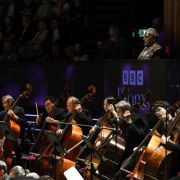
As an annual summer course founded by Claudio Abbado in Bolzano, the Mahler Academy has a comparatively recent but serious pedigree. Evidently the resource to match, too, having acquired a full-sized orchestral collection of Viennese instruments from the time when Mahler was the most celebrated conductor on both sides of the Atlantic. The Academy Orchestra brings together teachers and students as a project ensemble complicated by the demands of mastering these period instruments in pursuit of an Originalklang Mahler as envisioned by their conductor, Philipp von Steinaecker. Their recording of the Ninth Symphony holds more than academic interest, unpredictable in ways that made their UK debut at the penultimate night of the Proms an intriguing proposition.

The Ninth Symphony requires no such conceptual trappings in performance to land as an authentic expression of Mahler’s voice. Bruno Walter conducted the Vienna Philharmonic in both the premiere in 1912 and then the first recording in 1938, leaving an attested performance tradition. That recording documents the kind of quick and intense vibrato which Mahler himself seems to have cultivated as a conductor, even if would-be purveyors of authenticity in late-Romanticism have rejected it.
In the event, and in the Royal Albert Hall, the sound of the MAO was narrower than a modern orchestra, but built on firm foundations from the eight double basses arrayed across the back of the stage, Vienna Philharmonic style. Along with gently rocking horns and a lack of the usual late-Romantic string plush, they played with nasally penetrating clarinets and oboes; plunky and guitar-like harps; and trumpets straight off the Austrian parade grounds as recalled by Joseph Roth in The Radetzky March and Stefan Zweig in The World of Yesterday.

The Andante comodo was carried on wings of ghostly song, vestigially resembling in form and flow the long opening movements of Schubert’s String Quintet and last Quartet. Less oblique was the debt Mahler owed to Tchaikovsky, in the Ninth’s overall shape as modelled on the Pathétique Symphony, thanks in particular to the lyrically moulded finale. At the point of the first movement’s nemesis, complete with fanfaring trumpets and lugubrious trombones, von Steinaecker achieved a vivid flashback to the opening funeral march of the Fifth Symphony.
The second-movement Ländler I found especially persuasive, staged not as the conventional satire on rural manners but as a conflict between country and town evoked by the comically overdone country dance of the first theme and the one-in-a-bar swing of the second. Ravel’s La Valse would be the obvious – if anachronistic – reference point for this waltz on steroids, but a more pertinent (and contemporary) comparison suggested itself, with the culture clash between the swaggering Baron Ochs and the nouveau riche Faninals of Richard Strauss’ Der Rosenkavalier.

The following Rondo-Burleske sustained this hectic mood of garish caricature at the cost of some messy ensemble and lack of contrasting stillness in those remarkable episodes which anticipate the finale’s hymn of serene resignation. The pulse of this Adagio then gave von Steinaecker the space to stretch the Adagissimo of the last page until the line almost (but not quite) faltered, drawing the audience in to a spell of collective hush which was all too quickly and regrettably broken by a narcissist braying his enthusiasm from the bleachers.