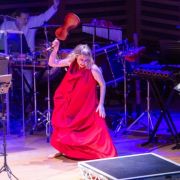
A concert with a focus on mental health was a bold move for Manchester Camerata at Kings Place, conducted by John Andrews. However, it was a theme that produced a stimulating and varied evening of music-making, exploring – directly and indirectly – the twists and turns of the mind.

The opening work, Judith Weir’s Blue Green hills, has nothing to do with mental anxiety, being a beautiful and delicate evocation of the Scottish Highlands. It weaves folksongs in a dreamlike manner through the impressionistic textures of the quintet of instruments. Always tasteful and perfectly formed, one was left with the feeling, as so often with Weir, that she is holding too much back. Less is more, but is it?
On the other hand her successor as Master of the King’s Music, Errollyn Wallen, is more generous and direct with her emotions. Her Ophelia setting By Gis and by Saint Charity, takes words from Hamlet, and is a short burst of deranged energy which perfectly captures that moment of decent into madness. Sung with power and character by Rebecca Hardwick, its effectiveness was more than the sum of its parts.

Next came an experiment that went wrong – Robert Schumann’s Kreisleriana arranged by Simon Parkin for piano, violin, cello, flute and clarinet. This set of exquisite piano miniatures hangs together by a gossamer thread which, more often than not, snaps in the hands of heavy-handed pianists. The chances of it being chopped up and put back together still holding onto its introspective beauty was a million-to-one. Not that the Camerata’s was not good in itself and without its beauties. One of those moments was the slow sixth movement with its glorious deep throated tune, played here with passion by Hannah Roberts on the cello.
From there we descended into the depths of George III’s mind, with the iconic Eight Songs for a Mad King by Peter Maxwell Davies. Composed in the late 1960s it became a calling card both for the young Max and for the British avant garde school. Alongside Harrison Birtwistle’s Punch and Judy, its extremes of mood ushered in a bolder strand to the British music scene which had been dominated by conservatives such as Britten.

Written originally for a baritone-actor, it was performed here by mezzo soprano, Rosie Middleton. Using a female voice was another experiment, which this time was brilliantly successful. Directed by Ruth Knight, Middleton’s King was elevated into an Elektra or Salome, crazed by the inevitability of a tragedy. The brilliantly varied instrumental accompaniment, performed with true commitment by the Camerata, was a Technicolor companion and an irritation to the singer. The balance changes with female vulnerability instead of male mania and all praise should be heaped on Middleton for her brave evocation and the vocal prowess of her performance. She managed to elicit sympathy and humanity amongst the darkness and disturbing absurdity of the work.