Half a century ago, I sat, as a fresh-faced music student, awe-struck in Philharmonic Hall. On the rostrum, conducting the Royal Liverpool Philharmonic Orchestra, was the slight figure of Aaron Copland himself, in a concert commemorating the USA's bicentennial, the composer conducting some of his own works.

Fast forward five decades and Copland was back at the hall, in musical spirit certainly, as the RLPO presented a celebration of the USA’s 250th anniversary. Curiously his Third Symphony has an eerie, if not unnerving parallel with the times in which we live. Conceived in the depths of World War 2, its conclusion is a celebration of the Allies' eventual victory and an adulation of the 'common man'. Some of the material is derived from his 1942 Fanfare for the Common Man.
Domingo Hindoyan led a stylish and soul-searching first movement, measured and confident. The massive climax was not overdone, even if the 90 musicians on the platform were seemingly giving their all. He allowed considerable flamboyance in the dance-like second movement which sparkled while the rather sombre third movement brought soul-seaching intensity. The huge fanfares in the finale were confident, almost brash, where the full power of the assembled brass was used to the fullest effect.
The opening work was something of a rarity on these shores. Adolphus Hailstork wrote his An American Port of Call in 1984. It is no doubt influenced by Norfolk, Virginia, where the composer has made his home. It's a work in perpetual motion where jazz and blues influences are brought to the fore. It arrives at an explosive end. In many ways, it is quite a challenging piece as so many threads are presented at once and the demands on the listener are legion.
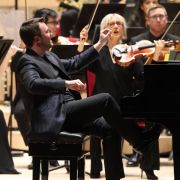
Then there came the star of the show. German pianist Frank Dupree was making his debut with the RLPO, as he has done with a number of other British orchestras this season. His performance of Gershwin's Piano Concerto in F was a brilliant triumph which drew that rare phenomenon in a British concert hall – a standing ovation. The opening movement was well paced and rhythmically tight. From the outset, Dupree's playing was shapely, sometimes fiery and impassioned, at other times introverted, but there was always enthusiasm and passion and the accelerando at the end of the movement added a new dimension of urgency.

A beguiling trumpet solo in the central movement enhanced the sultry piano entries which contrasted with the occasional cheeky, even comic, interlude. The finale felt like a coiled spring which was about to break loose. Massive energy and a huge orchestral sound brought the piece to a cataclysmic conclusion.
There was an encore, quite possibly the highlight of the entire evening. The whole percussion section came to the piano with bongo drums, tom-toms and maracas amongst other instruments. Dupree announced that they – including Hindoyan – would play Duke Ellington's Caravan. Dupree began plucking or strumming the piano strings before launching into a storming, semi-improvised performance which drew massive cheers from audience and orchestra alike.
Dupree's first visit to Hope Street will be remembered for his vivacity and infectious smile. It surely won’t be his last trip to Liverpool.