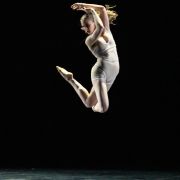
In the 2000s, the Books, whose songs layered strings with scraps of found sound, were so avant-garde that the French Ministry of Culture commissioned their music for an elevator in its building. Lauren Lovette, ex-New York City Ballet dancer and Paul Taylor’s first resident choreographer, has made a suite of dances to their songs, starting with 30 Incoming, which refers to messages on an answering-machine cassette found in a thrift store. The messages hint at a burgeoning romance: “Good morning, Mary. I thought I'd call you before I left to catch the bus.” Or perhaps a stalker. A scratchy, otherworldly soundscape emerged from spoken word layered with guitar, chanting, drumbeats and a throbbing dial tone.

To this, Lovette paired the meanderings of a pensive Elizabeth Chapa, a vision in a white gown reminiscent of Scarlett O’Hara. She gathered its tiered flounces and ran about in moonlight before ripping off the skirt and running around some more in her underwear – Mark Eric’s ethereal costumes employed a great deal of Velcro. The choreography was so thin it felt improvised on the spot, hardly a challenge for a Paul Taylor dancer. Four men ran on in filmy pyjamas; two of them leered at Chapa, who shrugged them off. For a moment, it looked as though we might get a homoerotic duet, but the men instead tangled gymnastically and sullenly. This episode resembled an arty Vogue photoshoot.

Emmy Wildermuth’s considerable talents were similarly wasted as the ensemble ripped off her white paper dress. She ran and spun, seemingly unfazed, even by the lyrics to Motherless Bastard, built on a recording of a whiny kid looking for Mommy and Daddy, only to have Daddy mess with his head: “You have no mother or father… they left, they went somewhere else.”
More of the same ensued, to tracks crafted around snippets of Mahatma Gandhi’s voice and someone shouting “God!” Women in filmy harem pants inexplicably ostracised Payton Primer, played tug-of-war and walked about with gestures pregnant with meaning that was never delivered. The rambling choreography was briefly enlivened by a shimmering drape descending from the flies to shroud Caleb Mansor, while Patrick Gamble ignored his predicament.

Lovette found her groove late in the game, in the two final tracks. The ensemble raced around, dressed like Josie Natori’s idea of mad scientists, drawing squiggles on imaginary whiteboards, as if deciphering garbled transmissions from outer space. The Books turned a New-Age mantra of acceptance, “I am who I am,” into a demented threat backed by a thundering techno beat. Think Mission Control at NASA doubling as a high-intensity rave. The choreography acquired an eye-catching structure, clusters forming and dissolving as if the crew were troubleshooting a lunar flyby. But overall, the costumes and Brandon Stirling Baker’s poetic lighting did much of the heavy lifting.

You’d think dance set to music as conceptual and intricately engineered as The Books’ would be similarly inventive, that together score and choreography would excavate old secrets and hidden conflicts. Instead, Lovette’s whole concept seemed to be using The Books.
Two older works that engaged more imaginatively and incisively with their scores bracketed Lovette’s 30 Incoming.

Robert Battle’s Under the Rhythm, a celebration of the jazz and protest songs he grew up with, was new last season. An anonymous chorus line in Santo Loquasto’s white shirts, suspenders and spats formed a steely backbone, repeatedly grabbing their throats in ominous semaphore to the growl and swagger of Wycliffe Gordon’s trombone in Down by the Riverside (Ain’t Gonna Study War No More). They broke loose to the hard-swinging One O’Clock Jump, with Alex Clayton and Payton Primer on fire. Patrick Gamble was quietly thrilling against spoken poetry layered over Steve Reich’s Clapping. Clayton and Lee Duveneck kept pace with Ella Fitzgerald’s scatting in Airmail Special, only to mime heart attacks at the end. Jessica Ferretti gestured urgently to Devon Louis at the start of a prayerful duet showcasing their sculpted beauty, backed by Gordon's trombone and Eric Scott Reed's piano.

Clever programming paired the Books’ sonic collages with John Herbert McDowell’s surgical splicing of Arcangelo Corelli, Henry Cowell and Malloy Miller for Paul Taylor’s 1976 Cloven Kingdom. Men in tails and women in swirling gowns stomped and minueted through this satire of society manners, donning nutty crowns and helmets made of mirrored fragments that shot shards of light around the house. The women squatted and convulsed as if about to lay giant eggs. Jessica Ferretti crawled out from under Elizabeth Chapa’s skirt instead. War drums summoned Devon Louis, Kenny Corrigan, Caleb Mansor and Patrick Gamble, who vaulted like grasshoppers, tumbled like acrobats, pranced with limp wrists and pounded their fists like frat boys. The mood turned sinister when the music died and the ensemble kept springing noiselessly side to side, necks jutting forward, arms flaring like an eagle’s wings warning off predators.