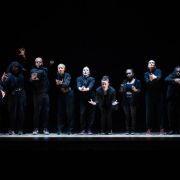
Michelle Dorrance, the tap dancer and founder artistic director of Dorrance Dance, alongside Bessie Award-winning choreographer b-girl Ephrat “Bounce” Asherie show the incisive ability for tap dance and a galaxy of other genres rooted in hip hop, street and footwork styles to tackle urgent societal concerns in the UK premiere of The Center Will Not Hold.

It’s an engaging performance that deepens our understanding of dance genres we think might only describe joyous self-expression or responsiveness to music. Tension, pain and feelings of unmooring are themes ripe for exploration within this work, making it a thoughtful start for Dorrance Dance’s ambitions to become a producer of original works that deepen the relationship between tap dance and other forms.
The original kernel of this hour-long performance was a 2022 duet made by Dorrance and Asherie entitled a little room which examined the performers’ relationship with their ageing bodies, physical pain and feeling confined in the wake of the Covid-19 global pandemic.

In collaborating with nine other artists all singular in their particular disciplines for this expansion of the original concept, Dorrance and Asherie allow private interrogation to evolve into collective response. Its title referencing W.B Yeats’ seminal poem The Second Coming, is a sophisticated allusion to the collapse of the organised status quo, with richer resonance when viewed in the context of mixing dance styles. If the centre will not hold when something strays too far from it, what does a production that pivots on the interchange of different styles offer the discussion?
Music-making, the way a body can determine the rhythm of a performance, is at the heart of The Center Will Not Hold, which features original music by Dorrance’s brother, Donovan Dorrance. Thrillingly, percussionist John Angeles is woven through the performance acting as conductor, agitator, collaborator and observer. The show opens with a compelling effect: we hear what one might think are bass drums from an orchestra. In actuality, Angeles uses his hands to animate a pulse for the unfolding dance. Dance is all about expressing music; in this performance Dorrance and Asherie demonstrate how integral rhythm is to tap dance and footwork styles that have grown out of the genre whose heyday was the jazz age.

Dorrance has said that The Center Will Not Hold is a direct response to the “oppressive and violent energy currently rising in America” and I was transfixed in the dark of the auditorium musing on human effort and what the fascinating integration of dance styles offers us at this moment. What holds the attention is seeing how the weight transfer between a dancers’ feet ricochets up the skeleton, so body shapes are never really designed, but are fascinating reactions to the conversations happening between foot and floor.
Lighting by Kathy Kaufman is an integral element to this production, creating different realms for the dancing. Tunnels of light like subway shafts, or ominous pools of luminescence focus our attention on imaginative footwork that throws the body off balance, the swoop of a leg catching the dancer right at the moment they look sure to fall to the ground.

The virtuosity on show is laudable with incredible b-boying from Matthew “Megawatt” West and Memphis Jookin’ from Charles “Lil Buck” Riley, but what intrigued me was the lyricism I found in the dancing of Fritzlyn Hector. Her ability to make visual the soaring flow of her upper body in contrast to fraught, complex footwork illustrate in dance terms the spirit of grace under pressure. Hector drew you in with her Zen-like centre, very definitely holding, against the complications around her.
So fertile is the material on show, The Center Will Not Hold warrants repeated viewing, particularly to the eye of a dance-goer less familiar with the footwork styles being drawn upon. The pace of this production moves confidently, dances passed between groups that expand and contract. Many of the performers plumb the depths of the New York’s Underground dance scene to hone their craft which makes me think about dance as social expression, away from the gilded theater and mirrored studio. What answers do you find when you’re dancing for yourself with the insistent pulse of the music as your only partner?

Amongst the darkness of the piece and its reflections on the current moment, there is a wonderful feeling of community in the shadows. The relationship between tap and the dynamic qualities of Black and Latine vernacular forms is diverse material and in carving out a place for these intersections to be on show, Dorrance and Asherie are making the lyric theatre world a richer place. How we get the centre to hold in our volatile world is to reach out in acts of willed collaboration so we can see the beauty in our differences, but be reminded of what we fundamentally share.