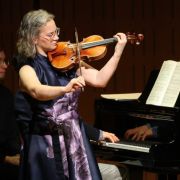
Concert mishaps are rare enough; two in one evening rarer still. Hilary Hahn’s electronic page-turner malfunctioned within minutes of the opening work, and later a snapped string forced an early interval. Neither incident unsettled the audience, who responded with warm and good-humoured applause. And rightly so, as Hahn’s tonal beauty and interpretative intelligence overcame every disruption.

French music dominated the evening, from the elusive sophistication of Ravel and Debussy to the lyrical refinement of Fauré, interspersed with two contemporary miniatures and a haunting nocturne by Lili Boulanger. Ravel’s Violin Sonata in G major contains an uneasy dialogue between instruments the composer considered fundamentally mismatched. Hahn and Tom Poster brought out this dichotomy; the former with her singing vibrato, the latter with his pared back clarity. The bitonal repeated notes on the piano were lithe and sardonic while the violin ended with a beautifully sustained high G.
Hahn heightened the Bluesy feel to the second movement with exaggerated glissandos and wide vibrato. Her pizzicato strumming was done with such abandon that it suggested a snapped string might be imminent. Though undeniably authentic in spirit, the movement might have benefited from a touch more Gallic irony. The Perpetuum mobile of the final movement crackled with energy.
Hahn briefly introduced the two contemporary works, both of which sat naturally within the programme’s Franco-American sensibility. Scott Tixier’s Resemblance, receiving only its second performance, blended jazz-inflected rhythms with more angular modern writing. Hahn played with cool restraint, allowing the work’s improvisatory character to emerge without overstating it. In Bun-Ching Lam’s Solitude d’Automne, virtuosity took a more inward form. Built largely from sustained harmonics and long-held lines, the piece demanded extraordinary control rather than overt display. Hahn’s slow bowing and finely graded dynamics gave the work a fragile, suspended atmosphere.
Debussy’s Violin Sonata in G minor was written just before his death in 1918. Here Hahn and Poster brought out the mercurial and at times melancholic nature. Poster created soft waves of sound at the piano before abrupt silences suddenly cooled the music’s emotional temperature.The second movement came to life with rippling, sudden arpeggios and ironic repeated notes. Before and after the snapped string halted proceedings, the third movement sparkled; swift scale passages were impressively handled while the muttering of the piano added to the pent-up excitement.
Hahn’s approach to Debussy’s La Fille aux cheveux lin was not self-indulgent, almost matter-of-fact. Taken at a flowing tempo it eschewed the haunting wistfulness that embodies this piece. The short Nocturne by Lili Boulanger was nothing short of magical with tender phrasing contrasting with passionate declarations.
Similar to saving the good wine until last, Hahn saved her best for the Fauré Violin Sonata in A major. This is where music and musician found the greatest union. From Poster’s rippling piano opening to Hahn’s wonderfully drawn lines of melody, richly inflected with vibrato, the music sang with intense feeling. The broken octaves were full of menace while there was a touching plaintive quality to the F major section. Dynamics were exquisitely judged in the second movement, where Hahn allowed a stillness to emerge from the pianissimo moments. The third movement ignited with taut, chasing dialogue between pianist and violinist. For the minor section there was a richer hue of colour. The swaying rhythm of the finale lulled us into a peaceful sound world before sudden burst of energy from the piano ignited the violin part too.
For all the evening’s unexpected interruptions, Hahn’s playing consistently returned the focus to what mattered most: line, colour and an unfailing sense of musical poise.