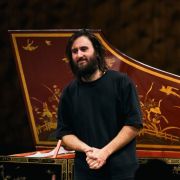
For devotees of early keyboard music, Louis Couperin is a canonical figure, though within the wider classical repertoire his name still lacks the universal recognition of Bach or Scarlatti. Jean Rondeau’s recently released set of Couperin’s complete harpsichord and organ works was conceived as an ambitious tribute to the composer’s 400th anniversary. As a central event of Hamburg’s Cembalomania series, Rondeau’s marathon recital – starting unusually early at 6pm – promised a comprehensive immersion into Couperin’s world. The outcome, however, was a considerable disappointment.

Rondeau’s Couperin unfolded as an almost self-contained monologue, narcissistic perhaps not in intention, but in effect. The performance seemed more concerned with inward contemplation than with engaging the listener, resulting in a non-communicative atmosphere. From the outset, the pervasive use of legato and over-legato touch created a homogenised sound world that, while undeniably polished, quickly became soporific. The harpsichord’s natural capacity for articulation, contrast and rhetorical clarity was largely softened.
Tempi throughout his Elbphilharmonie programme tended toward the slow, yet without sufficient musical substance to sustain tension. Although written repeats in dance movements were dutifully observed, they were rarely invested with new meaning. Aside from the occasional manual change – from lower to upper keyboard – that paradoxically rendered the texture thinner rather than more varied, repeats passed without re-phrasing, ornamentation or rhetorical reinvention.
Particularly problematic was Rondeau’s handling of the unmeasured preludes. Each was preceded by a short personal improvisatory passage, sometimes seemingly intended to evoke Frescobaldi and to suggest a historical bridge toward Couperin. Historically, préludes non mesurés functioned as moments of surprise and seduction, tools for capturing attention and asserting the performer’s imagination. Here, however, the extremely slow pacing and loosely suspended notes drained them of tension and sparkle, transforming what should have been moments of expectancy into diffuse, fleeting day-dreaming.
Across the inner movements of the suites, the same problem recurred. Allemandes and Courantes in particular lacked rhythmic impetus and physical presence; in the Allemande grave of the F major suite, gravity tipped into near immobility. Apart from the Piémontaise in the A minor suite, whose sharply articulated touch briefly restored energy, most dances proceeded in a uniformly controlled, legato manner. While Couperin’s writing often embraces contrapuntal density, the result here was dance music in name only; polished, but devoid of the physical drive and rhythmic vitality that define the genre.
The greatest disappointment lay in Couperin’s emblematic forms, the Chaconnes and character pieces. Rondeau’s readings of Chaconnes, remained largely uniform, offering minimal tonal or registral differentiation and failing to express the form’s imaginative variation of colour or texture, while articulating a clear cycle of beginning and end. Most troubling was the Tombeau de Mr Blancrocher; excessively free rubato undermined the music’s gravity and a sudden, near-toccata-like burst of improvisatory freedom toward the end felt stylistically incongruous, even disruptive, to a work grounded in restraint and controlled mourning. As with the great lament arias of Baroque opera, moments of profound grief leave no space for displays of self-conscious brilliance.
Ultimately, this recital stood as a concentrated expression of Rondeau’s personal aesthetic: a soft, caressing touch; an emphasis on low-register resonance; and a pronounced inclination toward introspection and meditative stillness. But on the occasion of Louis Couperin’s 400th anniversary, one could not escape the feeling that this music deserved a far more vivid, communicative and imaginative interpretation.