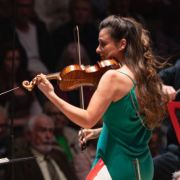
All good things, they say, come in threes. Sunday’s matinée at the Royal Festival Hall was indeed a case in point. A delightful suite extracted from Cécile Chaminade’s ballet symphonique Callirhoë arrived in the august company of two heavyweights of the concert stage, Elgar’s Violin Concerto and Debussy’s symphonic suite La Mer. It has to be said that Chaminade was not gate-crashing the party since Cristian Mӑcelaru and the Philharmonia welcomed her with open arms and three kisses on the cheek. Something might be made of the fact that Elgar arrived before Debussy, but both were royally received.

One doesn’t need to know much about the mythical plot of Callirhoë except that she, a princess, and her abductor, Alcmaeon, eventually fall in love (obviously with divine intervention), and live happily-ever-after (naturally). The stylish playing that Mӑcelaru elicited from the orchestra demonstrated that Chaminade had a gift for vivid illustration, well within established convention, but no less enticing and exciting for that. Her style doesn’t just tug at the heartstrings out of mere caprice; she knows that heartstrings are there to be tugged, and does so delightfully.
The expressive concerns of Elgar’s concerto and Debussy’s suite are separated by more than the stretch of water that is known as The Channel or La Manche. However, both works are defined by their composer’s magical gift for orchestration, mastery of form and an ineffable power of communication. That power of communication is also a gift in Nicola Benedetti and Mӑcelaru. They ripped through the concerto. In the first movement, Benedetti was the epitome of Edwardian elegance, in the second a lyrical and passionate seducer, and in the third the real stealer of fire from the gods. The Philharmonia’s publicity announced that Benedetti would “play Elgar”, but this was not just “playing”; it was a barnstorming performance beyond what one might expect at a matinée.
Critic Pierre Lalo famously professed not to have heard, seen or smelt the sea after attending an early performance of La Mer. It did not seem to have occurred to him that the sea is something that might be felt. Mӑcelaru’s emotionally-charged performance left me in no doubt that he has such an insight, drawing from the orchestra a torrent of fine detail and broad descriptive stokes that spoke of his deep understanding of the work. Had the audience begged for an encore neither he nor orchestra could have obliged; indeed, Mӑcelaru just about made it back to the platform for a third bow, so drained was he. If Samuel Taylor Coleridge’s idea that words are living powers has any traction, the same might be claimed for sounds; in particular hands both can be used for their capacity to enlighten and enthral. The forceful elemental sounds evoked in these performances made superb gifts for the Philharmonia’s 80th birthday season.