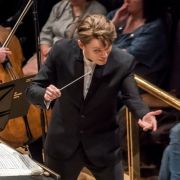
This BBC Philharmonic Orchestra programme, spanning French impressionism, contemporary myth-making and Russian symphonic grandeur, offered plenty of contrast. Under Adam Hickox’s direction, the orchestra was joined by pianist Elisabeth Brauß for a concert that moved fluidly between coloristic refinement and impressive virtuosity.

Premiered in 2023, Camille Pépin’s Les Eaux célestes is a brief work, telling the story of Orihime, daughter of the god of the sky. Cast in four continuously joined movements, Pépin employs quasi-Debussian harmonic language to create a shimmering, watery soundscape evoking the East. Hickox handled the piece with confidence, allowing textures to breathe while maintaining forward momentum. Orchestral colours were finely judged, and the BBC Phil responded with clarity and poise, particularly in the luminous upper strings and gently undulating woodwind lines.
A sharp whip crack announced the arrival of Ravel’s Piano Concerto in G major. From the outset, Brauß kept a tight rein on the tempo, refusing to let the Allegramente run away with itself. Her first solo entry was highly expressive, displaying a subtle and nuanced palette. Each staccato note felt carefully articulated, like a varied array of punctuation marks. The harp solo was delicate and fluid, subtly echoing Les Eaux célestes. In the lower register approaching the movement’s climax, Brauß showed an exceptional ability to voice the two hands, bringing clarity to passages that can otherwise sound heavy-handed.
Time seemed to stand still in the Adagio assai. Brauß took a moment of silence before beginning the extended opening solo, drawing the audience into an atmosphere of intense concentration. Her pianissimo was sublime, the phrasing eloquent and finely balanced. Particularly striking was her emphasis on inner voices, a refreshing interpretative choice that added depth to the texture of the piano writing. Gentle rubato enhanced an already expressive reading. Brauß and Hickox kept the dynamic range deliberately narrow, and through careful shaping and subtle colour changes, achieved a focused and intense movement.

The slightly broader tempi of the earlier movements made the Presto finale feel all the more exhilarating. Brauß’ dexterity here was dazzling. The audience’s enthusiasm was rewarded with an unexpected encore: Jonny Greenwood’s House of Woodcock from Phantom Thread, joined by the BBC Philharmonic strings. Its jazzy harmonies and airy textures echoed the Ravel, offering a moment of calm introspection into the interval.
Rachmaninov’s Symphonic Dances closed the programme. Hickox found a cinematic sweep in the first movement — Non allegro, linking naturally from the encore, though some softer moments lacked emotional weight. The second movement — Andante con moto, was notable for its balance and control, featuring a formidable solo from leader Zoë Beyers. While orchestral colours were bold, nuance was sometimes missing. The final movement had strong impetus and precise playing, though the light vibrato in the strings prevented the music from fully blooming, lending to an unnecessary chill. Throughout the evening, the BBCPO woodwind were outstanding, particularly in the Ravel and Rachmaninov their chemistry consistently drawing the ear.