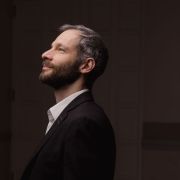
The first Pittsburgh Symphony subscription program of the new year saw the welcome return of conductor Dima Slobodeniouk. Though Russian born, the conductor trained in Finland and has spent much of his life there. Fittingly, Friday’s program opened and closed with works by Finnish composers – but not without a French interlude.

Lotta Wennäkoski wrote the five-minute curtain-raiser Flounce for the Last Night of the Proms in 2017. Energetic beginnings saw the clangorous resound of a very large orchestra, and the use of various extended techniques made it all the more intriguing for the ears. The composer endeavored to capture both meanings of the title: as a verb, encouraged by Slobodeniouk’s wide gestures, and as a noun, with more delicate material evoking decorative fabric.
Poulenc’s Concerto for Two Pianos hasn’t appeared on a PSO program in over half a century, but the present performance proved a piece this joyous deserves to be heard. Commanding the two Steinways on stage were Dutch brothers Lucas and Arthur Jussen in their local debuts. Like popping open a bottle of Champagne, the opening was effusive and exuberant. With their shared DNA, the Jussens operated as a single, twenty-fingered organism, whipping off the virtuoso demands with their sterling techniques.
In a more introspective moment, a dreamy interlude boasted a touching melody over rippling accompaniment. The central Larghetto evoked the slow movements of Mozart, but colored by piquant harmonies to give a delectable flavor. There was pure joie de vivre in the finale, with some particularly vigorous, rhythmically-driven playing in the pianos’ bass. The fun continued with the encore Strausseinander, Igor Roma’s stunning transcription based on Die Fledermaus.
The second half was a rather more serious affair, devoted to the Second Symphony of Jean Sibelius. The gentle resonance of the strings opened, joined by the equally genial winds and brass. Textures glowed with warmth, though not to excess as the labyrinthine work veered off into unexpected directions. Slobodeniouk offered thoughtful guidance, and climaxes were intense but tautly controlled with the conductor reining the musicians in to yield a more modernist bent, rather than unfettered Romantic abandon.
The slow movement evocatively painted a forlorn landscape, underpinned by pizzicato strings, and culminated in a bone-chilling close. The Scherzo, on the other hand, was a burst of energy, given with featherlight touch. Proceeding without pause, the opening of the finale glimpsed triumph, but the conductor ensured matters were still fairly subdued at this point, preferring to emphasize the long journey wherein each piece fell into place purposefully. I was further struck by the clarity of the layered textures, and the radiant statement which brought the piece to satisfying conclusion.