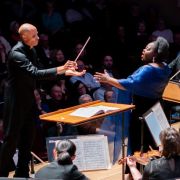
Beethoven the revolutionary is a common enough idea, but if his Symphony no. 7 in A major were to be thought of as a political tract, it would almost certainly be on a list of proscribed publications. It is so utterly compelling in its insistence that life is to be lived to the full, so marvellously confident in its rhetoric that exhorts us to sing, dance and frolic in the sun, there are those who would regard it as dangerous for those very reasons. Listening to the performance given by the Royal Philharmonic Orchestra, driven by Kevin John Edusei, I was mightily glad that the censors have yet to catch-up with that subversive text.

Edusei is clearly a card-carrying Beethovenian and on this showing an eloquent advocate to boot. The players of the RPO, of which he is Conductor-in-Residence, were all there for him: the woodwinds so transparent one could hear and see every line; the brass a bloom of amber in the slow movement and blast of vermillion in the finale; the strings mounting a masterclass in precision, poise and articulation. As for the timpani, it is unavoidable to note that they were played by Neil Hitt, but that does not describe the power of his whiplash strokes and his very fine imitation of a basso continuo. If you are in the UK, Edusei and his band will soon be near you; join them at the barricades.
To open the programme, Edusei gave an attentive reading of Samy Moussa’s Adgilis Deda: Hymn for Orchestra. The title is derived from the Georgian for “mother place” – so a place of protection. If the sound world of this ten-minute piece was meant to summon up such a place then I did not find it convincing. What was evident, however, was the warmth of the sound produced by the players as the texture morphed from one cloud to another, leading to their sudden evaporation.
The sense of reservation was soon dispelled in the most magnificent fashion: a performance of Strauss’ Four Last Songs in which soprano Masabane Cecilia Rangwanasha was simply fabulous. Her command of tone and colour was to the fore: the shimmer of a golden autumn; the astonishment of the lingering scent of roses; the ascent of larks in the darkening sky. In contemplating the repose of slumber, the echo of her thoughts was sung by the sublime violin solo of Duncan Riddell. Edusei’s pacing of each song was just so, and the support provided by the orchestra was resplendent with fine details. When Rangwanasha asks the final question “Could this perhaps be death?” there was a tremble in her voice, leaving the orchestra to decide. The audience wanted more, as did I, but time overtook us.