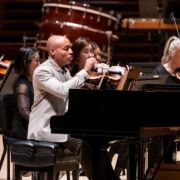
Before the Philadelphia Orchestra's afternoon concert on 15th May, Yannick Nézet-Séguin described Anton Bruckner, whose music dominated the program's second half, as the ultimate people pleaser. No one would dare affix that label to Tyshawn Sorey, whose Piano Concerto preceded Bruckner's Symphony no. 3 in D minor. Sorey, a 2024 Pulitzer Prize winner and professor at the University of Pennsylvania, told us not to expect business as usual with the title of his commissioned piece: For Marilyn Crispell evoked the renowned avant-garde jazz pianist, a friend and frequent collaborator, a leading practitioner of the controversial sub-genre known as "free jazz".

I've had the privilege of hearing Sorey and Crispell perform together, where their collaboration exuded the exhilarating spirit of improvisation so many jazz artists strive to capture. I wouldn't expect that to be replicated in a through-composed work, but this 30-minute, single-movement piece often seemed the opposite: it sounded rigid, forced and stultifying. Sorey eschewed the traditional push and pull of a Romantic concerto, but it frequently felt like the orchestra under Nézet-Séguin and soloist Aaron Diehl were on static, parallel plains: the small complement kept at a fixed tempo and modulation, some notes played deliberately under pitch, while Diehl repeated curt chords with little development or variation.
Some moments produced a mystical effect: the hum of tubular bells and vibraphone (reminiscent of Morton Feldman), the muted timpani strikes, the distant wail of a flugelhorn. But the spareness and austerity of Sorey's writing ultimately created a somnolent effect, to the point where an errant cell phone in the audience produced a momentary jolt that proved more exciting than annoying. Perhaps most disappointingly, the lack of collaboration continued, with Diehl's focused but wan playing remaining at arm's length. Sorey is clearly ambitious and fearless in a quest to create his own sound, but unlike a great jazz session, For Marilyn Crispell proved easier to admire than love.

Bruckner forged his own path too, although he relentlessly caved to colleagues and critics who couldn't understand his vision. For the Philadelphians’ first traversal of the Third Symphony in 20 years, Nézet-Séguin chose the composer's original 1873 orchestration, replete with the direct quotations from the Master of Bayreuth that would earn the work its nickname: The Wagner Symphony. Nézet-Séguin seemed to luxuriate in these passages, as if to affirm Bruckner's reverence for his elder. The appearance of the "sleep motif” from Die Walküre, with Jeffrey Khaner's flute sailing above honeyed strings, sounded particularly luscious.
The first movement's trumpet theme showed off James Vaughen, the orchestra's newly installed Principal, to great effect – and in a symphony where it really counts, the entire brass section thundered forth with a floor-shaking resonance. Yet Nézet-Séguin didn't entirely dispense with charm in favor of heft. Sure, the Scherzo felt a touch more imposing than rustically winsome, but the woodwinds in the Trio emerged with ideal transparency. He shaped the strings with great delicacy throughout, moving with ease from a whisper to a shout. Although the finale grew repetitive, the concluding shift from D minor to D major seemed to signal the value of Bruckner's then-unconventional approach to music, realized ideally as he would have wanted.