What a difference a day makes. Program A of the Dutch National Ballet’s brief tour to New York was a random grab bag of five rather unimpressive ballets. Program B, however, was an extremely strong evening of contemporary ballet. I was not familiar with any of the works on the program, but it was a joy to discover each of them. Like making new friends, so to speak.

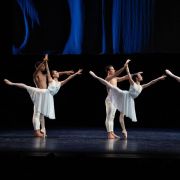
Hans van Manen’s Adagio Hammerklavier (1973) started the program. Choreographing to Beethoven is always risky. Beethoven’s works are often so harmonically dense that it works against the clear shapes and symmetry of ballet. But the famous adagio of the Hammerklavier Sonata made for a mesmerizing ballet. There were three couples, and each took their turn with a pas de deux. Each duet was a study in adagio dancing. While some of the moves have lost their novelty (like an overhead présage to a sudden upside down drop), the ballet seemed fresh and timeless. And in the few moments where the mind wandered, Beethoven’s music brought you right back.

As you might have predicted, Olga Smirnova and Jacopo Tissi danced the long final pas de deux. And if any two dancers are skilled at adagio work, it is these two. Just the way Smirnova unfurls a leg slowly in arabesque is stunning. I particularly loved the moment when he gently pulled her as she slid on the floor before lying down onstage. So simple, so poetic. This is one ballet where Smirnova’s exquisite, controlled and calculated style is appropriate. Tissi was a beautiful partner: strong and handsome.
Thando was choreographed and composed by Mthuthuzeli November. It is a short but intense duet that was helped by the hypnotic electronica-style music. The ballet was rather obviously inspired by William Forsythe (the yellowish costumes even looked a lot like the Herman Schmerman costumes), but that’s not a bad thing. Anna Tsygankova and Giorgi Potskhishvili were dark, glamorous, with a touch of danger. The audience loved it.

I did not have high hopes for Jiří Kylián’s Wings of Wax (1997) when the curtain came up. There was an upside down tree hanging on the stage and a circling, dangling light. It looked pretentious. I wasn’t hopeful about the music either (a hodgepodge ranging from Bach to Cage to Glass). The men and women wore simple black unitards and there was no pointe work.
But the ballet had a structure and mood that held your interest. It was abstract, but there was a theme of humans trying to connect. I really liked the propulsive middle section set to Glass music. Four couples flew around the stage. And Wings of Wax was beneath the contemporary ballet trappings, there was a strong romantic undertone. The final duet ended with two dancers circling the stage in a tight embrace, their necks rolling gently. Love wins.

The final ballet was Hans van Manen’s 5 Tangos (1977). Astor Piazzolla’s music was also used for Paul Taylor’s masterpiece Piazzolla Tango. Van Manen’s work is a bit too … happy? Without that push-pull tension that is at the heart of tango. Even the costumes (black dresses with bright red trim) looked sunny.
Despite occasional nods to tango (like the classic tango arm hold), the steps were also more ballet than ballroom. The section that got the biggest applause was when Young Gyu Choi flew around the stage in a manège of saut de basques. Not sure what that has to do with tango, but it made the audience happy. So it wasn’t a masterpiece, but it was fun to watch.
A word on the dancers: Olga Smirnova was obviously featured heavily in the promos. And she deserves it: she is a dancer of an exceptional caliber. But the whole company is filled with beautiful dancers – gorgeous lines, strong technique, versatile, neat fifth positions in even the most contemporary pieces. I would love to see them return with a more classical program in the future.