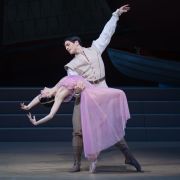
Dutch National Ballet premiered a new version of La Bayadère, updating the classical ballet for a contemporary audience. The full-length ballet about a warrior who’s sworn a love-oath to a temple dancer, only to betray her by agreeing to marry the Rajah’s daughter, has been a point of contention in the classical ballet canon for decades. The original ballet, choreographed by Marius Petipa in 1877, was set in a fantastical version of India, relying heavily on elaborate set designs and costumes that satiated Western curiousity and desire to be entertained by the exotic ‘other’. Dutch National Ballet has dared to strip La Bayadère of its antiquated colonial gaze, revealing the ballet’s strength in its classic narrative structure and formidable choreography.

The original ballet was set in an India imagined by and for Western audiences. This version of La Bayadère is located in the real historical setting of the South Indian city of Chennai during the Dutch colonial occupation beginning of the 17thcentury. The libretto, created by Dutch National’s artistic director Ted Brandsen and choreographer Rachel Beaujean, along with Dutch-Indian choreographer and anthropologist Kalpana Raghuraman and dance historian Dr. Priya Srinivasan – all of whom are credited as co-directors – gives the ballet a new sense of gravitas. Stripped of its original orientalism, Beaujean has done away with the ballet’s problematic gestures and movements, allowing the choreography to truly shine.

Ballet audiences delight in noteworthy onstage pairings, and I think it’s safe to say that Dutch National have quite a few on their roster. Case in point, principal dancers Anna Tsygankova and Giorgi Potskhishvili, who danced the leading roles of Nikiya and Solor on opening night. Tsygankova and Potskhishvili are a formidable pair, both expressive in their acting abilities and sparkling in their balletic prowess.
As Solor, now reimagined as a captain of the Dutch East India Company, Potskhishvili is exemplar of a male dancer akin to a professional athlete. There’s a rugged manliness to his movement quality that’s coupled with a nostalgic sense of bravado. The audience shared in his joy as he consistently pushed himself to defy gravity with every double cabriole and double tour. Classical ballet is about drama and Potskhishvili is a maximalist, often finishing his variations in a deep lunge, head thrown back in total surrender. The true marvel in Potskhishvili’s abilities is how he creates a sense of wild abandon whilst being in complete command of his technique.

Tsygankova as Nikiya, the temple dancer, remains the centre piece of La Bayadère and she did not disappoint in her dramatic abilities and refined technique. The polish in her lines and the sublime articulation of her pointe work are accentuated in partnership with Potskhishvili’s athleticism. During their pas de deux in Act 1, her complete stillness in her arabesque on pointe was an arresting moment that perfectly captured the breathless yearning of their love. Tsygankova has performed this role in its previous iteration, and her experience gave her opening night performance artistic depth and nuance. The chemistry between these principal dancers was palpable from the audience and hopefully to be enjoyed for seasons to come.

It’s a testament to the high level of talent of Dutch National Ballet that Tsygankova and Potskhishvili were not the only showstoppers of the evening. Principal dancer Riho Sakamoto did a stellar performance as Alida, whose engagement pas de deux with Solor matched Potskhishvili’s bold execution with her impressive jetés and textbook fouettés. Honourable mention goes to Sho Yamada’s beautifully danced Eclipse Statue and Nicolas Rapaic’s sinister portrayal of Lambert Hemsinck, a prominent textile merchant obsessed with possessing Nikiya for himself. His fitted black blazer lacquered in black scales down the back helped bring the character to life.

Both the set and costumes designed by Jérôme Kaplan stayed true to the production’s new vision, removing the exotic opulence in favour of a minimalist aesthetic with a colour palette of dusty pink, terra cotta and flecks of bronze. Not only did this allow for the spectacle of colours to dazzle in the costumes, it allowed the richness of the choreography, masterfully reinterpreted by Beaujean, to take centre stage, unencumbered.
The minimal aesthetic was most striking in Act 2’s ‘Kingdom of the Shades’, where the curvature of a set piece became a wonderous counterpoint to the famous ramp from which the corps de ballet enters. The corps women moved with purpose and the three variations by the lead Shades were elegantly danced. Connie Vowles had a nice clarity to her footwork and Salome Leverashvili performed with a charismatic confidence. Jessica Xuan brought a graceful restraint to her variation. The music, composed my Ludwig Minkus, was conducted by Koen Kessels, and while there was a part of me that wished to luxuriate in the music, particularly in Act 2, I did appreciate the brisk tempo that kept the ballet in motion.

For decades, opera has found innovative ways to reimagine classical works, sometimes subverting its original interpretation, other times creating new layers of meaning that speak more closely to our contemporary challenges. Dutch National Ballet has followed suit with its new La Bayadère, keeping the classical tradition intact while boldly investing resources to address the ballet’s shortcomings and critically engage with Dutch colonial heritage.