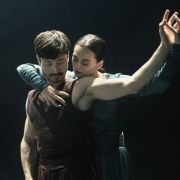
Akram Khan’s creative trajectory has followed a line of linked cycles with ideas tumbling from one work onto another until his inspiration moves on to the next arc. Lady Macbeth, his first creation for Royal Danish Ballet, elongates the continuum of Khan’s new style in contemporary ballet that began in a trio of collaborations with English National Ballet: Dust (2014), Giselle (2016) and Creature (2021).

Lady Macbeth expands upon the movement language, themes and motivations that are central to Khan’s creativity. He is on record as saying that history is based on a patriarchal perspective, and his new ballet gives an alternative, matriarchal view of Shakespeare’s Scottish play. It also denounces the rise of both toxic masculinity and dictatorship and the brutality that becomes the defining feature of both.
It is a faithful representation of Shakespeare, but for one crucial change. Khan’s profound sense of otherness has created a revisionist view of Lady Macbeth, not just in seeing events through her lens but by creating an empathetic foil to Macbeth, rather than the ambitious, Machiavellian kingmaker that Shakespeare described.

Lady Macbeth is set on this altered course by witnessing the brutal massacre of the seers, specifically not witches in Khan’s narrative, from which only three survive, one being Lady Macduff, a performance of intense vulnerability by Ji Min Hong. This scene is an example of Khan’s consummate skill in managing large numbers, as the seers are surrounded by King Duncan’s army. The central core of women, long hair flailing, dressed in identical grey costumes, contract and expand like a sea anemone while the soldiers encircle them with weapons raised. Although the consequent kaleidoscopic patterns are sublime, the preamble to the tastefully observed massacre is perhaps a little too long.

Khan has always been tremendous at portraying combat in choreography, going all the way back to his trio of works at the South Bank in the early 2000s when he represented the noble warriors, Arunja and his son Abhimanya. Here, as there, the pulling of a bow, the striking of a sword, is all portrayed with a sensitive and rhythmic intensity.
Although Khan is often defined by that sense of otherness, there is a satisfying sense of sameness about Lady Macbeth since his choreography replicates several themes and motifs apparent in earlier works. Dust was also rooted in feminism, focused on the importance of women in wartime, and contains a sequence of men joined in a wavy line by holding each other’s elbows: a similar memorable motif is represented here by the line of seers pulling their hair out to the sides, joining with the hands of their neighbour to create that same wavy line.

Another similarity comes from the Wilis in Khan’s Giselle, here the spirits of the seers are also permanently en pointe (as with Giselle, the only use of pointe shoes in the work) and their continuing bourrées come with powerful self-inflicted blows to their stomachs with resultant heavy contractions, reminiscent of those Wilis, albeit without the bamboos!
The familiarity with Khan’s Giselle goes beyond such motifs since the creative team is virtually identical. Vincenzo Lamagna composed the score, which is excellent, enveloping punctuations of choral singing and distinctive sound effects, including clockwork, predicting Macbeth’s inevitable demise, and loud banging on thin metal, like someone trying to break into a fridge door! Piano and percussion are perennial elements of Lamagna’s music, the latter accelerating momentum and intensity at key points in the ballet.

Another returnee is Tim Yip who repeats his theme of one monumental design motif. Giselle’s huge wall is now a massive set of tree roots that descend imperceptibly from the flies to rest on the floor for the work’s denouement before rising again.
Several sequences of emphatic group dances occur simultaneously with the miming of key secrets and encouragements amongst characters on the stage periphery. These key plot devices can be missed in the melee, although Michael Hulls’ lighting compensates by bringing crucial points of illumination to the overall sense of darkness.

This is an ensemble work where the whole performance organism often outweighs individual contributions although Stephanie Chen Gundorph successfully conveyed that counter-intuitive empathy in the title role, and Meirambek Nazargozhayev presented a strong portrait of Macbeth. They had palpable chemistry, especially in describing the gradual breakdown of their relationship, from the initial joy of a prelude pas de deux to eventual antipathy. Mathieu Rouaux was an imposing King Duncan and MacLean Hopper (Banquo) and Schonan Greve (Macduff) were also excellent in representing Shakespeare’s intent without his words.
Lady Macbeth is an excellent extension to Khan’s growing repertoire of contemporary ballet, reimagining the art through the lens of his classical Indian foundation. I look forward to more instalments to come, although I hear that he is tackling circus next. And so, another cycle begins!