In A General History of Music, Charles Burney repeatedly evoked the almost physiological impact that great singers exerted upon their opera audiences, capable of inducing swooning, hysteria or near-mystical exaltation. This concert performance of Giulio Cesare in Egitto at the Elbphilharmonie resulted in an evening that felt uncannily close to what Burney sought to describe: the embodiment – almost the reincarnation – of that volatile operatic electricity.

Il Pomo d’Oro’s playing was overwhelmingly muscular, everything unfolded under razor-sharp control. Dynamics were stacked with precision; crescendos accumulated in measured layers. Phrases were sculpted in short, incisive gestures, cut like gemstones and strung into a glittering necklace. The basso continuo painted a rich landscape, full of tense tremolos and pulsating energy. They reacted to the singers with spontaneity, turning recitatives into moments of genuine propulsion. Francesco Corti’s harpsichord playing remained vividly alive; rhythmically alert, subtly humorous and theatrically astute, at times echoing a singer’s phrase with a refreshing rephrasing.
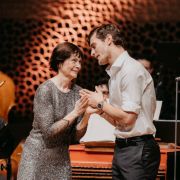
Virtually every aria emerged as a tour de force. Jakub Józef Orliński’s Cesare, paired with Sandrine Piau’s Cleopatra, projected an unmistakable radiance. Orliński’s Cesare was noble, elegant, almost princely, less a figure of dusty history than a living modern star. At moments he playfully competed with the horns in dazzling exchanges. His seamless shifts between registers carried a palpable physical charge and, from the initial delicate pianissimo to the climactic forte, his control of breath and dynamic shading was utterly unrivalled. In the da capo returns, his embellishments were consistently inventive, sometimes subtly reshaping the metric profile to create a finely chiseled tension.

Sandrine Piau’s Cleopatra emerged as a seasoned veteran. From calculated allure to the abyss of apparent defeat and finally to radiant triumph, she shaped Cleopatra’s arc with sovereign control and emotional depth. The character’s sensuality was never superficial, the partnership took on the subtle hue of an “older sister–younger brother” romance dynamic: her Cleopatra worldly and composed, set against a more youthful Cesare. Familiar arias were reborn through imaginative ornamentation and newly minted phrasings, proof of an artist who continues to reinvent from a position of mastery.
Rebecca Leggett’s Sesto and Beth Taylor’s Cornelia were bound together by shared grief and a fragile, hard-won resilience. Their Sicilian-rhythm duet unfolded with disarming sincerity, the two voices intertwining musically and psychologically, as mother and son clung to one another amid catastrophe. Taylor grounded the drama with gravitas and dignified sorrow. Her rich, dark-hued voice lent weight to Cornelia’s mourning, with flashes of vulnerability and sudden anger breaking through the surface. Leggett’s Sesto, by contrast, burned with youthful urgency. Her bright, focused mezzo carried a cutting immediacy, especially in the revenge arias, where rhythmic precision and dramatic commitment propelled the character forward. If the psychological arc from wounded boy to fully formed avenger was not entirely traced, the sheer vocal impact and emotional directness of her performance were undeniable.

Among the remaining male roles, Yuriy Mynenko’s Tolomeo was intriguingly unsettling. His agile countertenor captured the character’s volatility and capricious cruelty, even if one might have wished for a sharper edge of outright venom. Alex Rosen brought authority and vocal solidity to Achilla, projecting menace and ambition with darkly resonant command. Rémy Brès-Feuillet’s Nireno provided welcome suppleness and delight, while Marco Saccardin’s Curio offered firm and stylish support in his smaller role.
Ultimately, we can never fully inhabit the operatic splendour that Burney so vividly recorded, just as words today can scarcely capture the ecstatic intensity of this performance, already one of the definitive Baroque opera events of 2026.