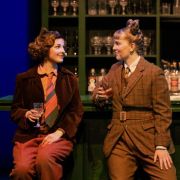
At the forefront of the Royal Northern College of Music’s ‘Legends and Lore’ core theme, running through the whole year, was this series of performances of Leoš Janáček’s ever popular The Cunning Little Vixen. The mature Janáček wrote the opera in the early 1920s in response to a newspaper serialisation of Rudolf Těsnohlídek story of the same name. Here it was presented in fully staged glory in the RNCM Theatre, accompanied superbly in the pit by a 21-piece ensemble performing Jonathan Lyness’ reduced orchestration version, sung in Sir David Poutney’s English translation.

Harry Fehr’s staging is relatively straightforward and traditional. The sets (by Nicky Shaw) saw most scenes feature a dozen or so huge columns as trees, with the Forester’s house and local inn appearing to either side of the stage when required. A bar and drinks cabinet was frequently used as a device to add colour to the animals’ world in the Forester’s vivid dreams. Costumes were traditional and simple, with impressive masks adding subtle detail. Abundant aesthetic richness was provided by the the enormous attention to choreography clearly in evidence here; this was a strikingly well-acted production from all protagonists, with no participant letting slip the mask of dramatic illusion. There was plenty of impressively nimble four-legged lolloping, hopping and forward-rolling, getting a fair few laughs from the audience. As the Forester’s old farm dog, Catcher, Sarah Rappoport was particularly impressive for her quadrupedal antics.

This four-performance run sees the major principal roles alternating between ‘red’ and ‘blue’ casts for two nights each. The highlight of tonight’s performance with the ‘red’ cast was undoubtedly the singing of soprano Clemetine Thompson as the Vixen Sharpears. The warmth of her tone across her range coupled with strong stage presence made for a richly expressive and complex characterisation which was fully deserving of her enthusiastic curtain call. She was presented as a ferociously intelligent and ruthless leader, stirring the chickens into rebellion with feminist encouragement before graphically murdering them all via the jugular. There was convincing tenderness in her interactions with her mate, Goldenmane. In this role, Esther Shea conveyed touching affection through her elegant vocal timbre.

Charlie Baker’s Forester was superbly characterised, giving a strong sense of his sympathy – and even affection? – for Sharpears in the context of his apparently loveless marriage to the severe Jemima Gray. His baritone was especially effective in the upper end of his range, though occasionally swallowed by unsympathetic balance in the lower tessitura. His friends the Schoolmaster and the Parson (Jay Broadhurst and Christian Loizou) were sung with musical assurance amid appropriate insobriety of demeanour, and Khaled Issa was an imposing Harašta. The remainder of the cast – mostly consistent across all performances in the run – were all individually commendable and collectively compelling as the voices of the forest. The large RNCM Opera Chorus relished a big set piece for the wedding scene which closes Act 1 as the happy couple are peppered with confetti.

Conductor Martin Pickard directed a tight ship with unwaveringly crisp ensemble between pit and stage. It might have been a quirk of the theatre’s acoustics that balance was occasionally skewed at the expense of the latter, but for the most part the accompaniment was sensitive and orchestral solos intensely vivid in colour. The quartet of woodwind players was especially impressive for their soloistic playing and meticulous attention to the finer points of articulation and phrases. There was certainly never any sense of something missing for the use of the reduced orchestration performing edition.

Overall this was a conceptually simple yet dramatically richly detailed performance in which drama and music were both afforded the requisite attention and care, making for a hugely enjoyable depiction of an entertaining comic strip.