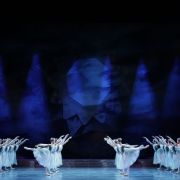
K-Ballet Tokyo first launched a project called K-Ballet Opto in 2022 in collaboration with the venue Bunkamura, which aims to explore the depth of dance by creating works with artists of different genres. The latest creation, A Dance Remembered in Tohno, is inspired by the book “Tohno Stories” by Kunio Yanagita, a famous humanities scholar known for founding and establishing Japanese folklore studies.

“Tohno Stories” is a compilation of folk tales from Tohno, situated in the Iwate prefecture (north east Japan) region that Yanagita collected. The idea of the work was to merge the story of a Kamikaze pilot engaged in a suicide mission during the Second World War. Crashing in the Tohno area, it was inspired by a love letter by an actual Kamikaze pilot whose spirit wanders in the Tohoku area in search of his fiancée, meeting a host of strange creatures depicted in “Tohno Stories”. A mysterious Boy K standing in the world between reality and fantasy, in the realms of this world and the other world, guides the Pilot on a strange journey.


The piece is the fruit of a unique combination of ballet, contemporary dance, butoh and kabuki. Direction and choreography is by Kaiji Moriyama, a contemporary choreographer and dancer, famous for directing the Opening Ceremony of the Tokyo Paralympics 2020. Moriyama conducted research in the Tohoku area, watching folklore festivals and participating in the ancient folk dance Shishi Odori that has been danced for 400 years. The many creatures that the Pilot meets were played by dancers from the leading butoh company Dairakudakan and Moriyama himself. The Dead Man was performed by legendary butoh artist Akaji Maro and the Boy K was Maholo Onoe, a 13-year-old kabuki actor from a famed kabuki dynasty. The protagonists and ensembles were the dancers of K-Ballet Tokyo.

The result was a powerful, mystical, strange world unfolding on stage, with careful merging of folklore and dance which presented a striking effect. The Pilot (Shoya Ishibashi of K-Ballet) encountered numerous mysterious creatures such as the Mountain Goddesses, Mountain men and Tengu (red-faced, long-nosed goblin); Snow Woman, breathtakingly danced by K-Ballet’s Saya Okubo who also plays The Fiancée; a procession of Souls and Deities (various creatures); Yamanba (Mountain hag) and Oshira sama – a woman who loved her horse so much that she ended up marrying him, delicately performed by Okubo with a puppet horse manipulated by dancers. Each sequence was uniquely memorable. The butoh dancers dancing the spirits were impressive with their powerful, low gravity movements. The most eye-catching moment was the swift and eloquent solo of the red Kappa (water goblin) danced by Moriyama himself. The duet with the Boy K and The Dead Man was thrilling with Onoe, a revelation displaying a natural charisma with his dramatic postures.


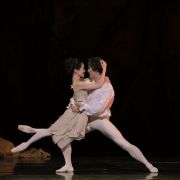
Ishibashi gave the performance of a lifetime, first marching as a soldier, manoeuvring his plane and crashing into the sea, his spirit wandering around the coast of Tohno. Guided by Boy K and encountering numerous creatures, he finally found his fiancée. Their duet was tender and caring with their souls yearning for each other, only to be finally separated forever. A festive Shishi Odori (deer dance of the Tohno district), that sends the spirit of the dead to the other world was the climax, where young Onoe gave a powerful, hypnotising kabuki solo, and finally The Pilot was given a send-off to death while fiercely dancing until his very last breath, making an unforgettable impact.

Music plays a large role in this dance work, as the shakuhachi (Japanese bamboo flute) player, Akikazu Nakamura is also the music director and composer, and the melody of this shakuhachi provokes a longing feeling for the Tohoku district. Koto (Japanese harp) and vocals, sung by Japanese folk singer Mase Kikuchi based in Tohno, were also performed live on stage, creating a mystical atmosphere of the district and the boundaries between life and death.

After the performances in Tokyo, this production will be touring to the actual Tohoku region, Yamagata, Akita, Sendai and Iwate where Tohno is located, with the final performance in Sapporo. A marvellous merging of Japanese folklore culture and legends with ballet and butoh blending together by Moriyama's masterful direction and skill. This piece should not be missed for people interested in Japanese culture as well as performing arts lovers.