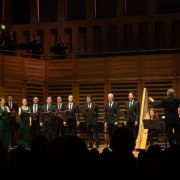
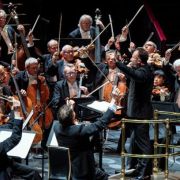
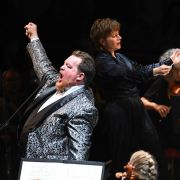
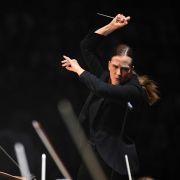
The BBC Singers’ gig on Thursday was predominantly for live BBC Radio 3 broadcast and – streaming it now – it does sound great. However, in situ, the small but perfectly formed Milton Court hall struggled to contain the BBC Singers’ mighty power, especially with the BBC Concert Orchestra. At climactic moments, particularly in the Herbert Howells’ Hymnus Paradisi, the wall of sound rendered discerning text nigh on impossible. The BBC Singers can certainly sing quietly, best evidenced in Caroline Shaw’s To the Hands, but elsewhere, the strings’ dynamics weren’t tempered enough to allow for this. Nonetheless, there was much to celebrate in this evening’s demonstration of this outstanding group of singers’ virtuosity, under the assured direction of Sofi Jeannin as she approaches the end of her tenure as Chief Conductor.


They opened with James MacMillan’s Who are these angels?, the choir accompanied by a string quartet. The opening attack from the tenors had a harsh edge, but they soon settled into a more unified sound, and the upper voices had beautiful bell-like clarity for the closing “And how will I know them?”. They were joined by the BBCCO strings for Shaw’s To the Hands, a response to Ad Manus from Buxtehude’s Membra Jesu Nostri. Shaw takes elements from Buxtehude, and extrapolates to meditate on humanity’s role in causing suffering, particularly for those around the world seeking refuge. A setting of Her beacon-hand beckons, a poem on the Statue of Liberty, and a spoken litany of data, in ascending order by country, of displaced people around the world have especially powerful impact. The BBC Singers upper voices in particular demonstrated their command with pure and precise onsets in the third section, and all voices communicated the emotion and intent of Shaw’s message with affecting immediacy.
Judith Weir’s brief My Guardian Angel had gentle simplicity, and from a tender opening, built to a warm conclusion. Its focus on the role of the angel watching over the birth of Christ was in stark contrast to Rautavaara’s Die erste Elegie, which offers a much darker, more terrifying interpretation of angels. The text is dense, and the twelve tone harmonic language adds further complexity. The BBC Singers were impressively on top of its challenges, from shrieking tenors at the opening to high sopranos emulating violins, and faultless tuning and pitching of leaping intervals, but after the immediacy of the Shaw and the simplicity of the Weir, this felt weighty in contrast.


The evening’s main event was Iain Farrington’s 2018 arrangement of Howell’s deeply personal Hymnus Paradisi. Remarkably, in reducing the orchestration to strings, organ, harp and timpani, Farrington manages to maintain the impact of Howell’s score. The throbbing of the harp and intense cellos and double basses at the start of the final movement is a case in point, and the waves of Howells’ build-up to the Alleluias loses none of its power. The BBC Singers relished the opportunity for much full-throated singing here, although this obscured some text. Soprano Emma Tring sang with a clear, full tone, although less from the orchestra would have allowed her to show us a little more dynamic range. BBC Singers new recruit Albert Soriano stepped up to the plate to replace indisposed Ben Durrant, with a beautifully judged, light tone, always alert and communicative. However, in the duet sections, and when pitched against the full strings and choir, his voice was occasionally lost in the hall (although the balance is notably resolved in the radio broadcast). Nevertheless, this was an impressive performance and a strong showing of the BBC Singers’ continued command and expertise.