Luciano Berio’s centennial passed, at least in the States, with little mention. At once one of the most challenging and appealing of the mid-century modernists, he enjoyed a successful career in New York City, where he lived through the 1960s, teaching at The Juilliard School and founding the Juilliard Ensemble. But due perhaps to parochial patriotism, it’s the homegrown composers – Cage, Copland, Feldman – who are celebrated.

New York’s Talea Ensemble began a belated birthday celebration a few days after Berio’s October birthday, though, launching a series spotlighting his Sequenza compositions for solo instruments. The first featured pianist Steve Beck and trumpeter Sam Jones. Plans for the second, on 9th December at Brooklyn’s Church of St Luke and St Matthew, were thrown in the air when flutist Barry Crawford pulled out sick. It became, violist Hannah Levinson explained at the beginning of the evening, a “more viola-forward recital” with a quick replacement and some fast adjustments.


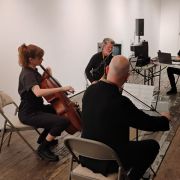
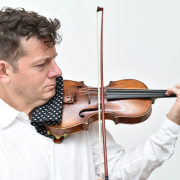
Flute works by Debussy, Varèse, Eun Young Lee and Reena Esmail were set aside. Violinist Maya Bennardo joined Levinson (her partner in the duo andPlay) to play Eva-Maria Houben’s 2008 Romantische Streiflichter (Jean Paul) and Laura Cocks stepped in to save Berio’s Sequenza I (composed in 1958).
The first half, at first blush, seemed fairly far removed from Berio’s virtuosic velocity. Bernardo and Levinson hovered around and within the sequence of seven intervals from which Romantische Streiflichter is built like a careful examination of a half dozen eggs. That opening quarter hour served to attenuate the ears, focus the mind and slow the metabolism, proceeding with extended pauses and underscored by the creaks and pops that old churches seem able to make on their own. But there was a clear progression. At midpoint, the playing grew rich and tonal after the scratchy whisperings that preceded. The fifth section struck a confident dissonance. The piece demanded attention – a demand which, of course, needn't be met, but meeting it stirred expectations and a sense of suspense.
Levinson then played Lauri Jõeleht’s solo Chant Harmonique (composed in 2014 and revised in 2020), building from Houben in bolder strokes (even vibrato!), moving more quickly but less metered, swelling into a gorgeously linear multiplicity and a clear resolution. Both composers, like Berio, took the instruments away from traditional roles. Houben and Jõeleht made them, in a sense, more environmental than musical.


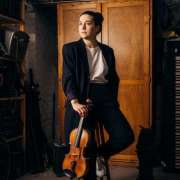
Cocks swayed as they played Berio’s Sequenza I, letting their right hand float away from the instrument, gently raising and holding a foot aloft, appearing focused, determined, assured and enthralled. Before playing, they spoke about how important the piece was to them and, indeed, how formative Berio’s entire set of solo works is for contemporary practice. The flutist has tricks up their sleeve. As executive director and performing member of TAK ensemble, they are a vital part of the New York new music scene. Given less than 24 hours to prepare the piece, they came through with aplomb.
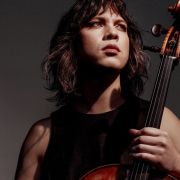
Levinson stood firm, as if in battle stance, for the closing Sequenza VI (1967), which indeed began in an absolute attack. As with the first piece, melodies were hidden within, but this time in a barbed wire nest rather than among passing clouds. Focus was again demanded, not just from Levinson, meticulous within the intensity, but from the listener, who might only find the musicality by listening for it. Eventually it opened enough to allow room to breathe, but even then the air seemed thin. Levinson noted that it had been written in tumultuous times. That may well explain its uneasy appeal today.