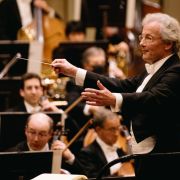
An orchestra can be technically immaculate without sounding as though it has one mind. The Cleveland Orchestra, however, possesses something more elusive: a collective sound so integrated that its cellos seem at times to speak as a single player, its violins to breathe in one phrase. Under Franz Welser-Möst, conducting with characteristic calm and economy, that unanimity was the lasting impression of Thursday’s packed Musikverein concert. If the evening’s second half left me admiring more than tingling, the first was a compelling reminder of what imaginative programming can reveal about a great orchestra.

Liszt’s Orpheus, a comparative rarity among his symphonic poems, opened a world of finely shaded colour. Originally conceived to introduce a Weimar performance of Gluck’s Orfeo ed Euridice, it imagines music less as spectacle than as a civilising, consoling force. The horns and two harps established an atmosphere of extraordinary delicacy, evoking its namesake’s lyre. The English horn, oboe and flute emerged with exceptional individuality, while the solo violin traced its lines with unaffected grace. Hearing the darkly rounded (non-Viennese) oboe sound in this famously Viennese acoustic was a particular pleasure. Welser-Möst never inflated the work’s quiet, busy rhetoric, and its many-layered filigree was given room to speak.
Bohuslav Martinů’s Second Symphony plunged us into an entirely different aesthetic, almost before the ear could prepare. The first movement begins in mid-conversation: motifs jostle, textures overlap, instrumental combinations continually rearrange themselves. The opening Allegro moderato took a moment to find my bearings in, but the pleasure soon lay in unpacking those those shifting layers rather than searching for a memorable tune. Particularly fine were the conversations among the woodwinds, the distinctive piano colouring of the Andante moderato, and the infectious, sometimes almost mischievously syncopated energy of the Poco allegro and propulsive finale. Somewhere between Stravinskian rhythmic invention, French neoclassicism and Czech folk inflection, Martinů creates a sound world unmistakably his own. Welser-Möst kept its seemingly unruly orchestral scoring wonderfully lucid. There was historical satisfaction, too, in hearing this work performed by the ensemble that premiered it in 1943. Commissioned by Cleveland’s Czech community and dedicated to Martinů’s fellow countrymen there, the symphony carries a history of exile and belonging without making a meal of either.
After the interval came Brahms’ Second Symphony, played with discipline, flexibility and polish. The unity of the string sections was a highlight; woodwind solos had character, and the violins possessed lift without sacrificing their luxurious blend. Yet from the unusually light, almost tentative opening Allegro non troppo, I wanted a little more golden-brown weight, a darker undertow beneath the pastoral ease. The Adagio was beautifully sustained, the Allegretto grazioso deftly articulated, its rhythmic contrasts delightful, and the finale perfectly controlled. What I missed were the moments of genuine surprise: an edge of eeriness, an unexpected change of perspective, even a real jolt from the almost cinematic brass theme which emerges toward the conclusion. Everything arrived perfectly prepared and nothing took my breath away. That is, admittedly, splitting hairs when confronted with playing of this calibre. The full house responded enthusiastically, and rightly so. After nearly a quarter-century together, Welser-Möst and Cleveland have achieved an extraordinary degree of collective understanding, a sound both transparent and remarkably unified. I simply found more to discover in the less familiar landscapes of Liszt and Martinů than in the beautifully tended, but somewhat predictable, Brahms.