The Paris Opera Ballet presented a mixed programme of contemporary works that encompassed various styles, highlighting the breadth of talent and artistry of the company.

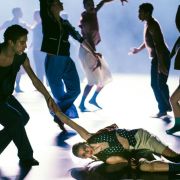
The evening opened with the world premiere Dreams This Way by Micaela Taylor, a new choreographic voice to the Paris Opera Ballet. Taylor’s dance lexicon sits squarely within today’s contemporary landscape, moving the small cast of dancers through elaborate group sections, exacting floor work and fleeting solos.
True to its title, Taylor’s work was distinctive by its concept supported by the set and costume design by Candice Mac. The piece began in what looked like the entrance of a lobby or office building, with dancers seated in a foyer. Behind the set piece was black scrim punctured with stars, creating an uneasy tension between the familiar and an unknown astral plane.


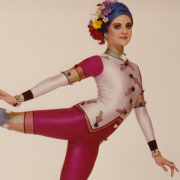
In its second movement, the lobby breaks apart, revealing more of a dreamscape with the dancers trading their everyday attire for a nude silhouette. Soloist Loup Marcualt-Derouard anchored the piece, presenting an abstract narrative that seemed to touch on the nightmares of capitalism and both Ida Viikonski and Baptiste Bénière in a bell hop costume were stand out characters with physical presence.
Dreams This Way felt like a patch work of various dance sequences that resembled other works. A beautifully danced pas de deux, for instance, felt eerily like déjà vu. But maybe that was the point? Overall, I appreciated the dancers commitment to the work, whose pairing of athletic physicality and Lynchian theatrics made for a strong opening to the night.

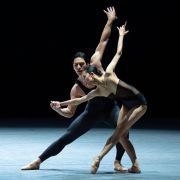
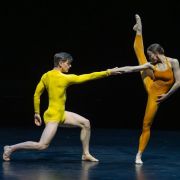
If Taylor’s work gave the audience a variety of concepts to chew on, Mats Ek’s Solo for Two was a perfect counterbalance; however, to call this master work a reprieve or palate cleanser would certainly not do it justice. Created in 1996, Solo for Two is an intimate portrayal of a couple and the emotional and feral attraction they have for each other. Amandine Albisson and Pablo Legasa were sublime, immersing themselves in the nuances and depth of the work. It is no easy feat to hold an audience captive for a solid twenty-five minutes, but Albisson and Legasa made it look effortless with their artistry and vulnerable partnership.
Mats Ek’s choreography is instantly recognizable: the lines are clean and precise that the dancers flow through the space which appears deceptively simple but is difficult to master. Even thirty years on, the choreographed use of the set designed wall was astounding. The power in which Albisson bounded toward the back wall and jumped placing both her feet on the wall, only to quickly turn her body and land on the ground, was nothing short of impressive.

There was such a magnetic quality to these dancers, I found myself moved by their characters' journey which resonated with moments of grief, aggression and sensuality. The disintegration of identities was also cleverly incorporated into the design and colour of the costumes. The exchange of garments at different moments was especially profound. Complicated and taut with delicious friction, this was a deeply satisfying character study of a complex relationship between two people.

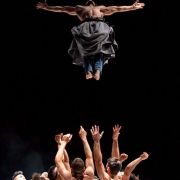
The evening ended with Crystal Pite’s The Seasons’ Canon, a seminal work that cemented her partnership with the Paris Opera Ballet and put her on the map as a choreographic powerhouse of large scale contemporary works for major ballet companies.

Set to Max Richter’s re-composition of Vivaldi’s Four Seasons, The Seasons’ Canon is a feat of organization where a swathe of dancers move throughout the stage both synchronically and canonically, creating waves of undulation and rapturous tableaus.
Here, Pite has taken her signature dance language and super-sized it with much success. Her fascination with nature, its decaying beauty and its never-ending sense of renewal, is fully realized with dancers in constant exchange, often physically linked in traveling formations with individuals breaking from the pack only to be subsumed again into the whole.

There's something about Pite’s aesthetic that is intentionally confrontational. There’s a repetitive panic and rigorous urgency in her movement. Fingers splayed open almost like claws slicing the air, the twitching of body parts becoming a kind of gestural flagellation. The piece ends with an unresolved yearning. Is it a hopeful ending or one of foreboding doom? Pite leaves you buzzing with questions.
Vibrations checks all the boxes for a well curated evening of contemporary works, masterfully programmed to showcase the company at its finest.