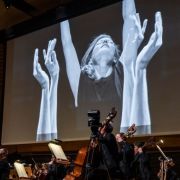
Conducting and singing the single role in La Voix humaine simultaneously might run the risk of turning Francis Poulenc’s harrowing monodrama from 1958 into a self-conscious gimmick of virtuoso multitasking. In her New York Philharmonic performance, however, Barbara Hannigan forged not only those roles but acting, stage movement and live video into a single, tightly controlled dramatic line that held the hall in tense silence, punctuated by uneasy laughter.

This staging, developed by Hannigan in collaboration with video artist Clemens Malinowski, integrates live projection with her Shiva-like split-personality performance. Dressed in loose black pants and T-shirt, Hannigan sang Elle, the sole protagonist of Jean Cocteau’s 1929 play as adapted by Poulenc, from the podium. Her image was captured live by platform cameras and projected in black and white onto a large screen behind the orchestra.
Malinowski’s video multiplied Hannigan’s presence into a continually shifting series of close-ups, overlays, freeze frames and the like. Visual ‘accompaniments’ too often degenerate into distracting competition with the music, but here they were effectively integrated with the larger concept, offering an analogue to the character’s unstable psychology as well as the stop-and-go patterns of Poulenc’s score.
Remarkably, Hannigan evaded any obvious visible division between her roles. Her conducting gestures were Elle’s own expressions: hands clasped in pleading shapes, fists hammering in frustration – movements that at once cued the orchestra and embodied Elle’s surges of angst. In this sense, gesture replaced Cocteau’s telephone and cord as a central symbol of Elle’s predicament. Rather than being tethered to a prop, the character’s emotional life was dispersed through the body itself – the act of musical control intriguingly doubling as the language of breakdown.
Vocally, Hannigan ranged from jagged outbursts to suspended, floating lines, with whispers, sighs and even audible breathing – subtly amplified through Étienne Démoulin’s sound design – becoming part of the expressive fabric. Poulenc’s orchestration, handled with acute precision, reinforced this sense of volatility: the brittle ‘ringing’ of the xylophone (surely an antique sonic signal for Zoomers), sudden surges of lyrical warmth across the ensemble and piquant harmonies that ratcheted up the sense of mounting unease. The rapport between Hannigan and the musicians was tight and sympathetic, the ensemble responding to her hybrid language of cue and character with total commitment.
Far from a stereotypical soprano ‘mad scene’, Poulenc’s score is a study in controlled instability. Hannigan’s Elle resisted easy pathos: at times fragile, at others excessive to the point of estrangement. Her oscillations between confession and self-correction, tenderness and denial, suggested a figure not simply unraveling but manipulating her own display, both enacting and performing her crisis – a portrait of the Artist at work in a superb con game. Whether tragic or overwrought remained deliberately unresolved.

Hannigan chose an unusual pairing to open the program. Composed in the final months of the Second World War, as the bombing of Munich and other cultural centers forced Richard Strauss into a reckoning with the destruction of the German tradition he had inherited, Metamorphosen fuses public mourning with an intensely private, even self-implicating grief. Civilizational collapse versus psychological disintegration in the Poulenc?
Strauss’ scoring for 23 strings is often approached as a grief-laden, late-Romantic elegy, saturated in dense sonorities and monumental phrasing. Not so Hannigan, who in this case ‘only’ conducted. Her deliberately light touch drew out transparent textures and inner lines – encouraging remarkably expressive phrasing from concertmaster Frank Huang and (soon-to-retire) principal cellist Carter Brey. What went missing was a sense of end-of-times devastation. The quote from Beethoven’s Eroica Funeral March wasn’t so much total resignation as a stifled sob – grief held in check rather than fully released, as if deferred to the Poulenc that followed.