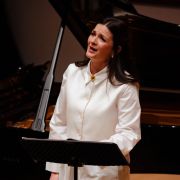
This year’s Leeds Song festival (once known as Leeds Lieder) gave well-known French mezzo-soprano Marianne Crebassa yet another opportunity to remind audiences that she is as potent and versatile in an intimate space as on a grand stage. With Leeds Song’s artistic director Joseph Middleton, the internationally revered pianist once described by the New York Times as “the perfect accompanist”, she delivered songs by Debussy, Mahler, Mompou and Ravel, in French, German and Catalan, all from memory, in the Venue at Leeds Conservatoire.

It was an exhilarating evening which began with Debussy’s Chansons de Bilitis in which the composer indulged his interest in the pagan world by using poems and a backstory for a narrator created by his friend Pierre Louÿs, just as James Macpherson had created a fictional narrator called Ossian in the 18th century. Here the poems are dreamily sensuous, with hints of the erotic, and Crebassa conveyed this quality brilliantly, along with a sense of amusement. She used her wide range to advantage in La Flûte de Pan, told a story with passion in La Chevelure, which ends with Wagner’s ‘Tristan chord’ and was full of appropriate anxiety in Le Tombeau des Naïdes. Middleton concluded the section with a beautiful and carefully nuanced rendering of La Fille aux cheveux de lin.
Gustav Mahler’s Kindertotenlieder followed, with its distinctly different tone. The composer selected just five from the hundreds of poems written in the early 19th century by Friedrich Rückert, for the various ways of dealing with grief and for their powerful emotional impact: the poems, written originally in reaction to the deaths of two of the poet’s children from scarlet fever, can strongly effect readers and listeners today without music, though Mahler transfigured them, and could be considered in the context of this festival alongside its Composers and Poets Forum, which is in the same programme. Singing in German with good English translations projected above her head, Crebassa used her great fluency with soprano notes, as well as low chesty ones which seemed more crucial in this cycle for delivering the essence of a tortured soul to the audience. This was particularly apparent in Nun will die Sonn’ so hell aufgeh’n (Now the sun prepares to rise as brightly) and also in Wenn dein Mütterlein (When your dear mother) with its feeling of yearning. She became much more animated for In diesem Wetter (In this weather), which I thought was appropriate to its stormy theme, but not over-operatic. I have in the past heard baritones sing this cycle, but Crebassa has convinced me that it is most suitable for a woman’s voice.

Outward-looking attitudes were more important in the songs by Federico Mompou in his cycle Combat del Somni, which followed, and Crebassa particularly excelled in delivering them in Fes-me la vida transparent (Make my life transparent). She related the sadness of Damunt de tu només les flors (Only the flowers above you) to her treatment of Mahler’s songs.
Maurice Ravel’s Cinq mélodies populaires grecques are more French than Greek, and must have made Crebassa feel like she was treading on home territory, because she began emphasising her body language much more, at times coming close to dancing. It was the right recovery piece for the evening, which she topped by moving into operatic mode with a terrific rendering of Bizet’s “Près des ramparts de Seville” from Carmen.