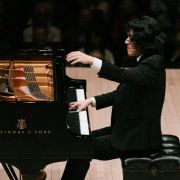
At Carnegie Hall, before a full house, Yunchan Lim paired Schubert with Scriabin in a program that, on paper, offered little beyond contrast. The performance nonetheless supplied its own logic: not a stylistic bridge, but a common ground rooted in the stretching and unmooring of musical time, oscillating between expansion and suspension.

In the Gasteiner Sonata, D.850, where momentum and structural drive take precedence over the more inward, song-inflected world of Franz Schubert’s late works, Lim avoided any suggestion of pictorial evocation despite the work’s association with an Alpine setting. Instead, his focus remained on the music’s abstract character, defined by articulation and proportion. At times, despite its clarity, his approach sat uneasily with the work’s more reflective moments, where a more elusive, introspective character emerges.
In the first movement, his touch was assured and flexible, and inner voices were projected with unusual clarity, forming an active contrapuntal layer within the texture. Despite tempos that occasionally felt overly brisk and risked compressing the sense of structure, every detail remained distinct, even as the music’s forward drive pressed against its frame. Beneath this surface, the music retained an undercurrent of ambiguity; sudden harmonic turns, embedded within the musical logic, felt quietly unsettling. The slow movement was shaped through restraint, its expressive range at times held in reserve. Its flow was sustained by a finely judged sense of direction, the movement’s wandering never lapsing into any sense of longueur.
The Scherzo retained a grounded rhythmic profile, its accents clearly etched without heaviness and its energy taut. In the finale, Lim again prioritised structure over brilliance, maintaining control as textures thickened and energy accumulated, while allowing fleeting touches of delicacy to lighten the surface. As in the first movement, transitions were handled with quiet assurance, their continuity preserved.

In the Scriabin sonatas, the handling of transitions became central to the musical argument. In the Second Sonata, atmosphere was present from the outset, with a finely graded palette of colour, never at the expense of line, and transitions unfolded as continuous transformations rather than discrete events. The music seemed at once suspended and directed in the first movement, unfolding in short, fragmentary gestures that unsettled the flow without breaking it. Textures shifted with increasing fluidity, and the figuration grew out of the preceding material, at times recalling the rapid, swirling patterns that had animated the close of the Schubert. The transition into the Presto drew the music into continuous motion, with clear voicing preserving distinct lines within the growing density.
The Third Sonata introduced a more overtly dramatic language, though Lim resisted exaggeration. Even at moments of heightened intensity, the playing remained centred, driven by voicing, not force. The music expanded and contracted with a sense of pressure, yet individual lines remained clearly defined. This approach clarified the structure while preserving its underlying tension.
In the Fourth Sonata, the process of continuous transformation became most clearly defined. The Andante established a state of arrested motion, moving toward dissolution. The Prestissimo volando did not aim for display; instead, it proceeded as a concentrated continuation of the musical process, culminating in a sonority that seemed to disperse rather than conclude, suspending resolution.
For an encore, Lim turned to Rachmaninov, Scriabin’s fellow student at the Moscow Conservatory, whose Vocalise suggested a return to the primacy of melody. Yet his avoidance of overt Romantic gesture recast it as something more restrained, the line unfolding with a controlled range of colour, shaped with the clarity and proportion that had defined the preceding works, even as time seemed to loosen its hold.