There are two certainties about any new programme of work by Acosta Danza, the London-based company of Cuban dancers founded by Carlos Acosta in 2015: one is the immense physicality and musicality of each member of this tremendous ensemble; and the other is an adventurous taste in commissioning choreography, which is always going to result in a hit or miss outcome, and in this case, it was regrettably more of the latter, with the new work significantly outshone by the revival.

The stated intention of this programme was an intersection of ‘the lush artistry of the Baroque period with the energy, creativity and vibrancy of Cuban dance’ but it was hard to detect a consistent baroque flavour throughout the programme.
Pearls, the opening work, probably comes closest to the objective of Cuban baroque but it was also distinctly disappointing. This new piece by Cretan choreographer Andonis Foniadakis, is set to a live performance of Esteban Sallas’ liturgical Salve Regina, embedded in a score composed by Julien Tarride, which has been created as a chaconne, with a looping architecture of continuing variations always returning to the same theme. It started with a realistic baroque sound from the strings, moving through choral music and eventually morphing into pulsating contemporary Cuban rhythms followed by a nightclub rave that could easily have been the head-banging rampant, noisy choreography of Hofesh Shechter.


The idea of this eclectic soundscape – where both baroque and Cuban influences and live and electronic music joust with one another – seemed terribly clever on paper, but in reality, it seemed like music in search of a theme, which translated into choreography that also seemed to see movement circling back on repeat. Foniadakis’ choreography is fast-paced and punctuated with vital and often sudden contrasts that then realign into fusion. Crucially, Pearls is also a work that passed through several false endings, continuing well beyond the point of no return. Either a delicious male duet or a breathless male/female duet would have provided an emphatic full stop but even after raucous applause Pearls began again…and again!
The continually moving lighting designs by Nicolas Fischtel with laser-like red beams creating triangles and other geometric shapes was a creative element that worked very well although I felt that Anastasios Sofroniou’s costumes, especially the women’s leotards, were dreadfully unflattering.

The influence of the chaconne continued after the interval as the programme closed with Goyo Montero’s powerful Chacona, a one-act ballet that was originally created as the conclusion of a full-length work, VASOS COMUNICANTES, made in 2011 for the Staatstheater Nürnberg Ballett during Montero’s 17-year tenure as director. It was performed by Birmingham Royal Ballet early in Acosta’s reign as artistic director and so is not new to British audiences.
Chacona is set to the final movement of Johan Sebastian Bach’s Partita No.2 in D Minor for violin, which is expanded in this performance to include guitar and piano, each instrument being performed in successive solos. Credit is due to the three excellent musicians Pepe Gavilondo (piano) Ezo Sarici (violin) and Adrian Aguiar (guitar).


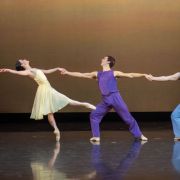
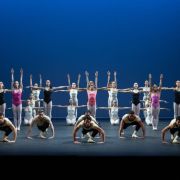
Montero’s choreography contrasts individual and group movement, with sequences of connection and disruption. The work is physically and musically challenging, requiring precision in unity from the sixteen dancers, performing alongside and within oblongs of light. The dancers’ cohesion was impressive, but they were occasionally out of synch with the lighting.
There is no doubt that Acosta Danza is one of the most exciting contemporary dance companies of current times, possibly now challenging Rambert for the top dog spot. Rambert has been around for a century and Acosta Danza for just a decade but, despite the odd choreographic blip, as here, this young pup is coming on fast.