Canadian Opera Company’s double bill of Bartók’s Duke Bluebeard’s Castle and Schoenberg’s Erwartung is a revival of a 1993 Robert Lepage production (last seen in 2015) and was, in its day, one of the company’s first ‘modern’ productions. It has worn remarkably well and is still fresh and compelling in the current revival directed by François Racine.

Michael Levine’s sets are framed by a sort of giant gold picture frame with a scrim. Behind this, for the Bartók, is a perspective box raked up towards the back of the stage. On one wall is a projection of massive blocks, on the other projections of seven keyholes. After a brief appearance at the front of the stage, Bluebeard and Judith enter from the back and work down the line of keyholes, room by room. As each of the first five doors opens we don’t see inside but light and projections flood the opposite wall and the back of the scrim with suggestive imagery. Judith’s white wedding dress gets gradually bloodier. It’s spectacular and really beautiful. Lighting designer Robert Thomson and media designer Laurie-Shawn Borzovoy did a rather wonderful job, especially when one considers this was using 1990s technology.


For the sixth door’s ‘Lake of Tears’ there’s actually a pool well forward on the stage which Judith splashes about in but perhaps the most startling imagery comes when the seventh door is opened. Three former wives, all in red, emerge from below the stage and process slowly before adorning Judith with the star spangled black cape she will wear as the wife of eternal night. Everyone leaves the stage by the upstage exit before Bluebeard appears to deliver his final monologue from in front of the scrim.

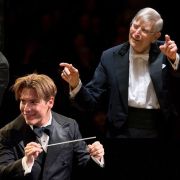
Musically it was excellent too. Christian Van Horn’s sinewy baritone was just sinister enough and powerfully projected over the huge orchestra. Karen Cargill conveyed both determination and a touch of vulnerability in a rather beautiful voice that was big enough (just). But pride of place goes to conductor Johannes Debus and the excellent COC orchestra. Judgement of dynamics was excellent and the tension never flagged, a fine combination of beauty and power coming from the pit. Coupled with the visuals it made for edge-of-the-seat drama.
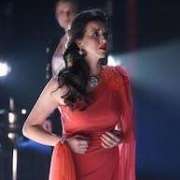
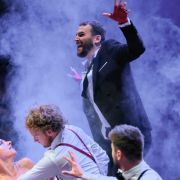
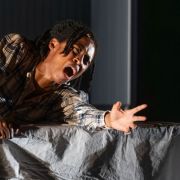
For Erwartung, one wall of the perspective box is removed leaving a single wall through and over which things happen. Unlike Bluebeard, where much is suggested and little shown, here much more is shown that, canonically, takes place in the Woman’s imagination or not at all. Here the Woman appears to be a patient in some sort of mental health facility. experiencing flashbacks. She is watched much of the time by a white-coated psychiatrist figure. Various incidents, most notably when she imagines her lover having an affair, are played out rather literally, in slow motion, by actors. Technically it’s very skilled again. Props and actors appear and disappear seamlessly as parts of the stage are completely hidden by the lighting plot which often has the Woman in a bright spotlight which pretty much obscures everything else. In this case the Bluebeard pool becomes a pool of blood into which the lover’s mistress disappears!


Anna Gabler did a fine job of creating ambiguity around the Woman’s mental state while singing with power and as much lyricism as Schoenberg’s abrasive music allows. Once again, Debus and the orchestra were on top form with this very tricky score. I didn’t feel Erwartung was quite as compelling as Bluebeard but it was still very good. Taken together, they make compelling music theatre that has worn remarkably well.