Rene Orth's 10 Days in a Madhouse is an unusual opera. To a libretto by Hannah Moscovitch, it is a chamber opera based on the research and writings of 19th-century journalist Nellie Bly who went undercover at the Women’s Lunatic Asylum on Blackwell’s Island, New York, in order to expose the neglect and mistreatment of the patients. It’s told in reverse, starting with Day 10 and working back to Nellie’s committal, followed by a brief summary of what happened afterwards. So, for example, we are introduced to an important character, Lizzie, as she is dying, graphically, from typhus, before we learn her story and how it intersects with Nellie’s.

Musically too it’s innovative. Orth creates two sound worlds; an acoustic, and often quite beautiful one, embodying sanity, and an electronic, often abrasive, soundscape for madness. These are blended to create the appropriate balance in each scene.


Andrew Lieberman’s set a cylinder with passages running through it, vaguely reminiscent of a Panopticon. The orchestra and conductor are placed on the top of the cylinder, high above the stage. This gives director Joanna Settle lots to work with in terms of entrances and exits, characters running in circles, appearing and disappearing. This does, however, pose co-ordination problems for conductor Sandra Horst as evidenced by the number of monitors around the theatre!

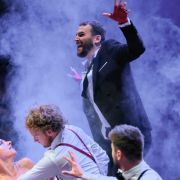
There are some remarkably effective scenes. The relationship between Mireille Asselin’s Nellie and Jorell Williams’s Dr Blackwell is the backbone of the drama and it’s quite subtle. Blackwell isn’t evil but he’s pretty much devoid of imagination and repeats words and actions over and over despite Nellie’s best efforts. To him, she is female and mad. Nothing she says or does can penetrate his sense of omnipotence, to her increasing frustration. Around this there are some very effective scenes. It’s particularly shocking that we first see Lizzie (Taylor-Alexis Du Pont) in the process of dying, horribly, of typhus because later (earlier) we will meet her in conversation with Nellie and obviously far from mad. She’s also central to the scene where the Nurse (Lauren Pearl) tries to get the women to sing a hymn of resignation. The result is musically horrible, which says a lot about the skill of the nine woman chorus. It’s genuinely hard to sing that badly! But into this cacophony Lizzie inserts the spiritual Go Down Moses, creating a frisson of rebellion. It’s one of many memorable moments.


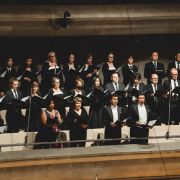
Asselin was a powerhouse from beginning to end, utterly believable. Williams was convincing and coped very well with a fairly high baritone role and Du Pont took her chances to shine with some fine, idiomatic singing and subtle acting. The nine woman chorus was collectively excellent with many members having important solo cameos. The 13-piece ensemble “on the roof’ was quite heavy on brass and percussion, blending skilfully with the pre-recorded electronics. Despite the logistical issues Horst kept everything very tight with no co-ordination issues.
It’s been a bit of a tortuous journey to get 10 Days in a Madhouse to Toronto despite it being a Tapestry Opera co-commission with Opera Philadelphia, where it premiered in 2023. But finally Tapestry, in partnership with the Canadian Opera Company and the Luminato Festival, have brought it to the Bluma Appel Theatre. It’s 90 minutes of innovative and imaginative music theatre that’s well worth seeing.