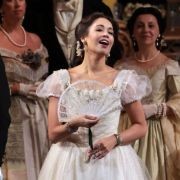
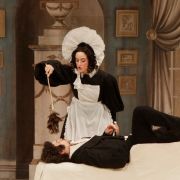
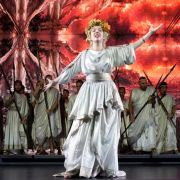
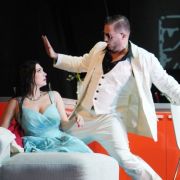
The Grand Théâtre de Genève (currently housed in the Bâtiment des Forces Motrices) presents a new production of Castor et Pollux, an opera based on the twins of Greek mythology, written by Jean-Philippe Rameau in 1737; the composer substantially revised it in 1754, adding more ballet music, removing the Prologue and rearranging the dramatic timeline.

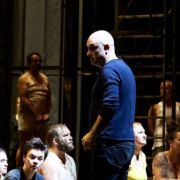
Edward Clug’s new production is built around minimalist sets by Marko Japelj, consisting of a few large rectangular blocks that shifted position, some chairs, and video projections on the backdrop resembling astronomical images of nebulae, subtly evolving over time. The costumes, designed by Leo Kulaš, are largely modern and anonymous, predominantly in various shades of grey for the humans, while the gods and fantastic creatures don more extravagant outfits, with Mercury in a shiny costume resembling Spider-Man.

Despite the presence of several excellent dancers, there was relatively little actual dancing: performers were often seen contorting themselves in corners, crawling inside shopping trollies, or sliding across a floor covered in milk. There was no clearly discernible conceptual thread in Clug’s staging; however, it never directly contradicted the music, and the singers were able to perform without obstruction.


Conductor Leonardo García-Alarcón chose the original 1737 version, though he also removed the Prologue, which is unrelated to the main plot, a common occurrence in Baroque opera. He led his orchestra, Cappella Mediterranea, in a highly personal interpretation of Rameau’s score, a generous portion of which consists of recitatives accompanied either by continuo or by full orchestra. While it is stylistically appropriate to slow down at the end of phrases in recitative – often with a rallentando on the characteristic trill and appoggiatura to convey heightened emotion – Alarcón adopted an overall slow tempo for entire recitative passages, overusing this device and ultimately draining the musical line of both flow and expressive vitality. The result was a general lack of the lightness and elegance characteristic of the French Baroque style, which Rameau may have expanded (with respect to the strictness of Lully’s canon) but never fully abandoned. In the faster orchestral sections, there also seemed at times to be an overemphasis on percussion and strummed theorbo (or guitar), which again contributed to a certain heaviness in the overall sound. That said, Cappella Mediterranea performed with precision and refinement, with Victor Theuerkauff particularly impressive on trumpet in the Act I scene of the athletes.

Andreas Wolf sang Pollux with a resonant and authoritative bass-baritone, his lower register secure and his upper range controlled and beautiful. His interpretation was intense and nuanced: Pollux is perhaps the most fully developed character in the opera, torn between his love for Télaïre and for his brother, who also loves the same woman and is loved back. Wolf successfully conveyed his emotional complexity, particularly moving was his portrayal of Pollux’s realisation that his immortality is ultimately empty if it cannot inspire love.
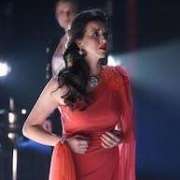
Télaïre was sung by Sophie Junker, whose soprano was bright and appealing, though perhaps lacking some depth for the role. At times she seemed to deliberately suppress her vibrato, resulting in a somewhat fixed tone, but overall, her performance was satisfying, with a voice that remained beautiful throughout its range. She managed to convey both her sincere love for Castor and her manipulation of Pollux into sharing his immortality with his brother, bringing him back to life.


Phoebe, Télaïre’s sister and secretly in love with Pollux, was portrayed by Ève-Maud Hubeaux, whose mezzo-soprano was even across registers, with focused high notes and a solid lower range. Her interpretation occasionally veered toward exaggeration, but this suited the character’s obsessive love, which ultimately drives her to suicide.
Reinoud van Mechelen, as Castor, offered the most beautiful voice of the evening: his haute-contre was remarkably effortless in the upper register while retaining strength and heroism. He demonstrated an instinctive command of the French Baroque style, singing with natural ease and expressive grace.
Jupiter was sung by Alexandre Duhamel, whose bass, though smooth and pleasant, did not always convey the authority expected of the king of the gods. Sahi Ratia delivered the Athlete’s aria with a strong, ringing tenor, and Giulia Bolcato made a notable impression in the smaller roles of a “heavenly pleasure” and a “happy shade,” her soprano bright, silvery, and agile.
The opera ends with La fête de l’univers, where stars and planets join Jupiter in celebrating through song and dance the ascension of Castor and Pollux in the sky as the Gemini constellation. The choreography was a bit lacking, consisting of the chorus walking in circles while pushing shopping trollies, but the final chaconne, followed by the chorus “Que les Cieux, que la Terre et l'Onde,” was glorious.
Laura's trip to Geneva was sponsored by the Grand Théâtre de Genève.