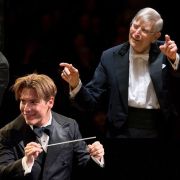
“If my life had flowed calmly I would not have been able to compose.” So said Gustav Mahler opening up – at last, after several cancellations – to his therapist. At least, he did at Saturday night’s Aurora Orchestra Prom, ‘Mahler’s First by Heart’.

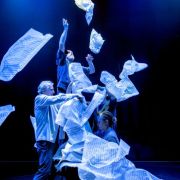
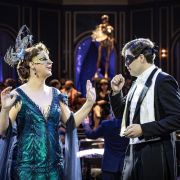
Jane Mitchell’s lively dramatisation of the symphony’s origin story is based on Mahler’s own writings and is an impressive work of musical history that wears its learning lightly, beginning with the unfavourable reception of the symphony’s first performance raining down in recorded barbs around the Royal Albert Hall. “A complete disaster”: just one of the choice phrases that we are to assume has undermined Gustav’s faith in himself. Sarah Twomey as a patient, no-nonsense Sigmund Freud, teased out her client’s formative experiences – the death in childhood of eight siblings, his father’s cruelty to his mother, a doomed early love affair. Jack Bardoe gives us a Mahler every bit as intense as the original, though leavened with the affectionate humour of hindsight.


So much more fun and a hundred times more memorable than reading it in the programme, the story was enriched with interjections from Nicholas Collon, introducing some of the music’s key themes, as well as giving some useful info on the breeding cycle of the cuckoo, with the help of the orchestra who were on standby across the back of the stage. Then it was the audience’s turn to sing Frères Jacques in three parts around the hall before hearing how a klezmer band can crash even the most sombre of occasions. In a clever bit of programming, Natalie Lewis sang the Songs of the Wayfarer with a gentle intensity that perfectly captured the bittersweetness of a lost first love.

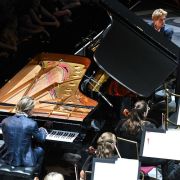
And so to the symphony itself, and the not inconsiderable task of performing it not just from memory but ‘by heart’. It showed. Without the paraphernalia of stands and chairs, and no dots to look at, the orchestra were free to look around at each other and to move expressively. The result was a Mahler 1 that felt, if not revolutionary, then fresh, organic and loved. It’s no bad thing either, when so much of the music we hear these days is compressed by streaming, that playing a musical instrument is a properly physical activity. Whether you were one of those who could anticipate every bar, or whether you were hearing it all for the first time or somewhere in between, the sense of having all travelled together to the climactic fourth movement and its sudden ray of light, was palpable.


There was a lot of love for this piece at the Proms... and for Aurora. Both will have won over some new hearts and ears on Saturday night.