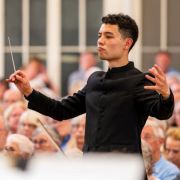
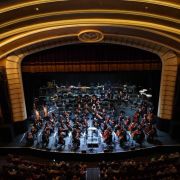
The BBC Symphony Orchestra brought an appropriately all-American programme to the Proms, continuing the season’s celebration of the US Declaration of Independence. Under James Gaffigan, the evening ranged from the jazz-inflected language of Wynton Marsalis to Gershwin’s unmistakable voice, before concluding with Barber’s powerful First Symphony.

Wynton Marsalis’s Concerto for Orchestra occupied the entire first half. A BBC co-commission, first performed in Cologne by the WDR Symphony Orchestra, it received its UK premiere tonight. In six titled movements, the work lacks much real meat to get one’s teeth into. The title inevitably invites comparison with Bartók’s Concerto for Orchestra; at around 38 minutes, length may be their only similarity. Marsalis’s language is clearly jazz-infused, though less Duke Ellington than Stravinsky. Each movement contains a myriad of short ideas which recur without always dovetailing coherently. There is plenty of fizz, but perhaps too much of it to make individual ideas as memorable as those in Bartók or Stravinsky’s jazz-infused works.


There were movements of note. Who Struck John? opens with percussion and explores orchestral textures and timbres, with episodes seemingly nodding towards An American in Paris but lacking cohesion. Group Speak has flashes of trad jazz, though seems almost too deliberate in pursuing them. It Comes in Waves is cartoonish, while the fifth movement could well accompany a black-and-white film. The final movement, Say What?, is the most melodic and dramatic. Overall, this is an approachable piece, but it lacks anything sufficiently memorable, melodically or rhythmically. The titles add little, while the programme notes unfortunately offered no meaningful insight.
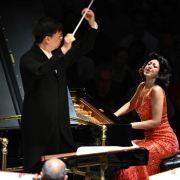
After the interval, Gershwin’s Piano Concerto in F came like a breath of fresh air — particularly after the day’s extreme heat and in a slightly stuffy Royal Albert Hall. Yeol Eum Son joined the BBCSO, whose orchestral opening burst with energy and rich colour. Son’s entrance was much more introspective, calm and reflective, with a strong sense of spontaneity. Gaffigan's orchestral balance was superb, although the strings’ rhythmic rigidity jarred with the more relaxed woodwind and brass. Towards the end, the strings responded to the winds and percussion, bringing a stylish conclusion to the Allegro.

The second movement was wonderfully faithful to its markings: the Adagio was sultry, while the Andante had real movement. Niall Keatley’s trumpet solo was stylish, his vibrato conjuring a late-night scene in New York. Son played with simplicity, and her cadenza shimmered with translucent colour. The third movement was enjoyably bass-led, though the Allegro agitato lacked the opening movement’s excitement and felt underpowered. Son’s technique was flawless, particularly in the astonishing speed of the repeated notes, while the piano retained a beautiful sound even at its most percussive. It was disappointing that the finale lacked momentum. Son was not going to leave without giving the Prommers an encore: Walter Gieseking’s Tempo di Charleston from Three Dance Improvisations provided a fitting conclusion.


Samuel Barber’s Symphony no. 1 in completed the evening. First performed in 1936, it shares structural and musical similarities with Walton’s First Symphony of 1935. Its European tonal language contrasts sharply with the programme’s jazz-infused works, but Gaffigan and the BBCSO gave an excellent account of this orchestral rarity. Although cast in one movement, it contains four sections following the traditional symphonic model. A passionate Allegro ma non troppo gave way to a nimble Scherzo, in which Gaffigan seemed to greatly relish the material. The Andante tranquillo featured a beguiling oboe solo from Alison Teale, while the Con moto finale, a passacaglia influenced by Sibelius, grew darker and increasingly intense. Without doubt, it was the performance of the evening.