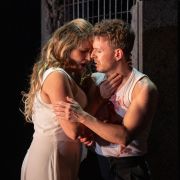
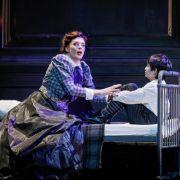
Humperdinck’s Hänsel und Gretel is State Opera of South Australia’s second fairy tale opera this year, after Rossini’s La Cenerentola in May, and is an equally interesting production with excellent musical values. The pre-publicity suggested this would be a particularly dark interpretation, but it’s hard to imagine how it would be much darker than the original with its themes of cannibalism and immolation, and indeed most of Grimm’s stories are inherently darker than those of Perrault. In any case, as the opera hews much closer to its original than does Rossini’s, so the production, directed by Constantine Costi, is faithful to Humperdinck’s intentions, the main exception being that the Witch is sung by the same person as the Mother, not an entirely new idea, and psychologically plausible.

As the curtain rose, a forest of stylised pine trees came into view through a misty landscape. A small cutaway two-storey house revolved into view, disappeared, re-appeared with a family of four, revolved again, to return once more with just the two children. This effective use of the stage revolve in the not overly large stage was used to good effect, with credit to set and costume designer Jonathon Oxlade. When the Father reappeared, he was at the very top of the tallest tree, bringing good cheer to the family... except that the children were missing, as he finally realises.


The Witch is also initially glimpsed at the top of the forest, waving her symbolic tempting oversized spoon. The gingerbread house appears as a tiny thing suspended in midair; after the children start to lick it, the Witch’s face appears within. She is also represented by red hands, giant versions of which encroach on the stage from either side; in her own person, she also has bright red hair and lipstick. The costumes for the family were pretty much as usually imagined for a 19th-century depiction, in shades of blue and grey, with bushy white wigs for the children. The Sandman is a jolly figure in a conical hat and white ruff over a voluminous maroon onesie, while the Dew Fairy is a striking apparition with a headdress like an astronomical circle, and a glittering pantaloon outfit.

A magical moment is created for the end of Act 1, when the Evening Prayer is heralded by a single lantern appearing on the revolve, gradually multiplying, then children in green come to take up the lanterns and protectively gather over the sleeping children. The magic dissipated somewhat as the children continued to meander around a tad too long. For the final scene, a wall descended near the front of the stage, which included an arch with bars within which to imprison Hänsel, and a gaping oven for obvious purposes.

The Adelaide Symphony Orchestra was conducted by Dane Lam, also the artistic director of SOSA; he provided an ebullient introduction before the start. The beguiling sonorities of the score were handsomely captured, with careful attention to tempi and dynamics. The strings sounded particularly sumptuous. The State Opera Children’s Chorus did not have a great deal to do vocally, but what they did was very well done, as were their movements which had them on stage more frequently.


All the solo singers sang and acted their parts to perfection, with nice German diction. Gretel was gorgeously sung by American born Sofia Troncoso, whose cleanly produced accurate soprano had a lovely bloom on the high notes. Hänsel is usually sung by a mezzo-soprano, but in this instance we were graced with the entertaining Korean countertenor, Kangmin Justin Kim. One small drawback is that the timbre of his voice is unnervingly similar to that of Troncoso, so we missed the usual differentiation of the sibling voices, which is of course not to detract from his excellent singing. (Also he doesn’t get a chance to show off his coloratura chops!). Well-known Australian mezzo-soprano Catherine Carby sang the parts of both Mother and Witch, easily negotiating both tessiture, and characterising well the harassed careworn Mother on the one hand, and the insinuating malevolence of the Witch. Australian baritone Morgan Pearse sang the Father with resonant bronze tone, and local soprano Lucy Stoddart sang both the Sandman and the Dew Fairy in joyful and tunefully enjoyable renditions pointing to a promising future.