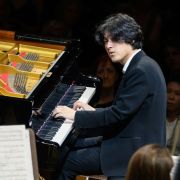
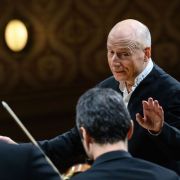
The all-star pairing of piano prodigies Lucas and Arthur Jussen with the Academy of St Martin in the Fields promised an evening of sterling collaboration – and delivered much more. From the way they were dressed to their style of playing, the brothers comported themselves not as soloists, but as members of the orchestra, broadening and brightening its sound. It was a remarkable symbiosis that lifted a program of Johann Christian Bach, Johann Sebastian Bach and Mozart to sublime levels.

The Jussens joined the orchestra for two of the four pieces on the program, Mozart’s Concerto for Three Pianos and Orchestra and JS Bach’s Concerto for Two Keyboards and String, BWV1060. Mozart revised the former several years after its 1776 premiere so that he could play it with his sister, and the brothers handled its technical demands with facility and grace. Their playing was firm but supple, authoritative in execution with just the right touches of lyricism and tenderness. The orchestra provided a sturdy framework with a high-spirited opening, a shimmering second movement rich in nuances and a showcase in the finale for sparkling cadenzas. The Jussens handled their duo solos like virtuosos, offering delicate interplay and the poetry of rhyming lines.


Though it didn’t hit quite the same peaks, the Bach concerto cast a familiar work in fresh terms. After a vigorous opening, the orchestra’s gentle pizzicato and a sensitive touch on echoing keyboards lent the second movement the air of a lullaby, an effect enhanced by a hushed, drawn-out close. An energetic third movement surged with strong contrasts and the brothers fully integrated into the orchestra, their piano breaks part of an unbroken, dynamic flow. As with the Mozart, the Jussens were totally subsumed in the music, playing as one with the orchestra, expressive but tightly controlled, never flashy.
Enthusiastic applause from both audience and orchestra broke the spell, with the brothers treated like star soloists. They responded with a four-handed treatment (on a single keyboard) of the aria Schafe können sicher weiden (Sheep may safely graze) from Bach’s “hunting” cantata, BWV208. In keeping with their posture for the evening, it was subdued, a quietly heartwarming coda to a mature, thoughtful performance.
The ASMF ensemble plays early music like no one else, in a full-bodied, exuberant style that provided bracing bookends for the concert. Opening with JC Bach’s Sinfonia in G minor, the players barreled through the first movement with such fervor that the music nearly buzzed. The slower second movement was no less emphatic, while a driving third movement offered dramatic contrasts. The piece has built-in intensity, but the striking fullness and depth of the sound came entirely from the musicians. In their hands, the music took on symphonic dimensions, grander and more expansive than is typical of a period chamber orchestra.


Mozart’s Symphony no. 29 in A major closed out the evening in much the same fashion, though the opening movement lacked some of the depth of the Bach opener. Still, there was no loss of momentum, despite the many sudden turns in the music, which the ensemble spun out with gusto. The middle movement was notable for its light, floating quality – even the brass soared. And adroit handling of the final movement gave the sound a silken finish, with a brisk tempo and smart phrasing retaining its vivacity.
On their own, either the ASMF or the Jussen brothers would have provided a thoroughly engaging and edifying evening. Together, they were like alchemy, turning the music into gold.