In one highly efficient mixed program, the tiny, intrepid New York Theatre Ballet illustrated ballet’s manifold approaches to storytelling: in the manner of a Russian epic novel; in abstract form resonant with a larger theme; through childlike games that hint at a shared past; and by rejecting storytelling outright.
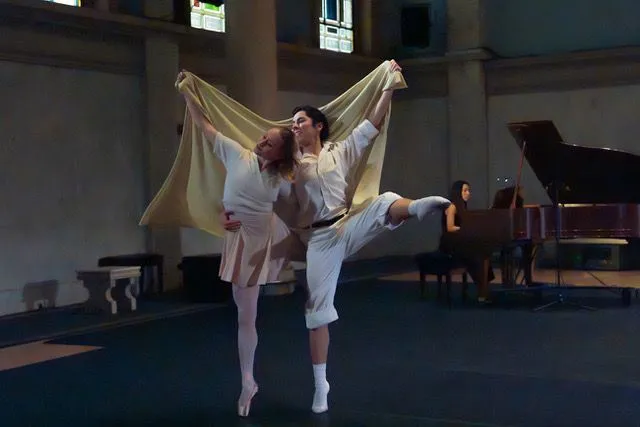
Antony Tudor’s Little Improvisations unfold in a dreamscape of childhood memories, evoked in this performance by the sensitive, spirited playing of Renee Ong at the piano. Schumann’s Kinderszenen reverberated through the high, airy sanctuary of Judson Memorial Church. In the opening melody, Ong made the five-note line breathe almost imperceptibly, a moment of inward suspension. Time briefly withheld, then repaid, also shaped the duet executed superbly and unaffectedly by Giana Parlin and Isaac A. Garcia, whose innocent yet brimming gazes met for the briefest moments between bursts of sparkling footwork, airy lifts and games of “pretend”. Before they drifted back to sleep, Parlin sank from a balance on pointe, like an exquisite exhale, to rest her head on Garcia’s knee.


Two world premieres proved gripping in different ways.
Kevin Iega Jeff’s Noi-Tar-Gim packed a lifetime of joys and vicissitudes into a visually striking ensemble work, its layered industrial soundscape by Darryl J. Hoffman amplifying instability and shadowy terrors. Tenacity and hope also surfaced in brief, restless encounters between dancers who embodied either figures in transit or elements of the shifting landscape: hills to climb, trains to board, machinery to wrestle, menacing forces to confront.

Iega Jeff has spent decades making theatrically potent work centered on the histories of the African diaspora, notably for Chicago’s Deeply Rooted Dance Theater. From the outset, drama was assured when the statuesque Sarah Simon Wolff sought refuge in a tight clinch with Mitchell Welsh, one leg yanked skyward. Each striking tableau dissolved as the ensemble had somewhere else to go, some other demon to fight. Filmy, layered costumes swirled beautifully; newsboy caps, fedoras and other mid-century headwear anchored the piece in time. Kristina Shaw stood out in a sequence of fiery turns, but the work ultimately triumphed through its taut ensemble.

Julian Donahue set All the Flowers Are Behind Us to the restless grandeur of Piano 2 by Julius Eastman, from a groundbreaking body of work only now being rediscovered decades after his death. As chords rained down like weather – heard here in recording – the dancers scudded across the floor in windblown steps, the tight choreography intensely musical, with Balanchinean echoes also evident in the asymmetrical tunics, identical for men and women, in obsidian over bare legs. A woman fell; the others tossed blood-red calla lilies over her. Isaac Garcia hovered over her prone form, his angular pose shaping a temporary shelter, his eyes full of doom.
At first cradled or wielded like daggers, these artificial flowers were later arrayed in a fan of spear-like rays behind Sarah Fernanda Stafford’s shoulders, a stylized halo or crown. At the close, she encounters a single white flower – apparently real – in a bowl of water, gazing at it as if at something alien. A program note describes the piece as “delving into the uncertainty of our shared future”, contrasting organic beauty with stark artificiality. The distinction is clear enough; the note feels unnecessary, even stifling, for a work as richly evocative as this.


The program note for Iega Jeff’s piece was sparse, merely nodding to “the often complex ties between fathers and sons”. A touch more specificity about the history behind the work might have sharpened its contours.

Stories do not intrude on Merce Cunningham’s How to Pass, Kick, Fall and Run. It was a provocation at its 1965 premiere. It’s still irritating.
Theater veterans Peter Francis James and Paul Lazar, in suit and tie, popped a bottle of champagne downstage before settling in to read a randomly chosen series of anecdotes from a collection by John Cage. Not even James’s soothing baritone (he has played Barack Obama onstage) could sustain interest in these morsels of dated whimsy. The dancers, meanwhile, in jewel-toned jumpers and black tights, bounded, whirled and worked their way through their own counts. When James and Lazar spoke over one another, the chaos was exhausting.

Elevated concept aside, the absurdist energy had its entrancing moments – notably when the dancers resembled sandpipers foraging on mudflats: scouring the ground, they stretched one leg out, then popped the standing heel into a forced arch. And in the phlegmatic yet strangely tender negotiation between Garcia and Stafford, who took turns encircling the other’s waist while extending a leg to clear space for the other’s.
New York Theatre Ballet is no stranger to Cunningham; this young cohort embraces his singular virtuosity. But this is not one of Cunningham’s transporting works; at a time of global precarity, we want to be transported.