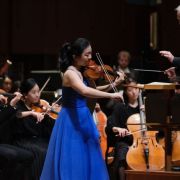
Some contemporary listeners look askance at Samuel Barber, regarding his irony deficient, neo-Romantic compositions as quaint at best and reactionary at worst. But in Philadelphia – where the composer grew up and received his education at the Curtis Institute – he remains a favorite son. The Philadelphia Orchestra premiered Barber’s Violin Concerto in 1941, and it has remained a cornerstone of the outfit’s concerto repertoire ever since. This season it served as a welcome showcase for Augustin Hadelich, whose plush tone and elegant demeanor on stage suited the introspective work like a glove.


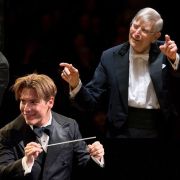
A program inevitably emerges when considering this concerto: Barber wrote the first two movements in Europe, amid an idyllic summer spent in Switzerland and Paris, and the final movement back home, when America’s entrance into World War 2 was all but certain. The angular rhythms and cutting triplets of the Presto finale eviscerate the relative calm of the Allegro and Andante preceding it, requiring a soloist who can turn from repose to urgency on a dime. Hadelich had no problem here, from his unadorned entrance in the first movement to his finger-twisting double stops near the end. Guest conductor Dalia Stasevska kept the orchestral accompaniment relatively spare throughout, keeping Hadelich’s virtuosity in focus, although Phillipe Tondre’s oboe solo in the second movement deserves its own mention.
After rousing applause, Hadelich returned with a favorite encore: his own arrangement of the 20th century folk song Orange Blossom Special, notable both for dexterity and wit. Hadelich’s inclusion of American roots music in the encore repertoire remains an admirable project.
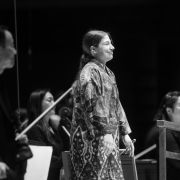
Stasevska returned after intermission to lead Mahler’s Symphony no. 4 in G minor, another favorite of this orchestra. Her reading came alive in its climaxes and contrasts – especially in the dynamic shift that ends the first movement, which was heartstopping, and the unhurried mood of the third. Elsewhere, though, her interpretation lacked a defined point of view, moving haphazardly between Mozartian stylishness and juicy overstatement without much reason. What it lacked entirely was a sense of Alpine rusticity – particularly in the Scherzo, where David Kim’s scordatura violin solo failed to thrill. Stasevska’s relentless, rubato-free tempo in the finale taxed soprano Joélle Harvey, causing her interpretation of Das himmlische Leben to sound more frantic than childlike.


The afternoon also included a lively reading of John Adams’ Short Ride in a Fast Machine, notable for its brass fanfares and hard-charging percussive elements. At five minutes, it proved the perfect length to appreciate the composer’s “post-Minimalist” style. And when Stasevska returns to the podium next week, she will introduce the work of another Curtis Institute graduate too long overlooked in these environs: Julius Eastman.