It’s impossible to overstate how influential Steve Reich’s music has been on the contemporary classical landscape. Minimalism, of which he and Philip Glass were the most visible early masters, shifted the center of gravity of new music half a century ago from forbidding complexity to a more accessible language that nevertheless proved to have the potential for unexpected depths.

That richness was on proud display at Carnegie Hall’s ‘Steve Reich at 90’ concert, featuring Ensemble Signal and the Bang on a Can All-Stars. Rather than being a retrospective covering his whole career, three of the five pieces presented were recent, including two US premieres, with the only nod to the 20th century being Electric Counterpoint, hailing from 1987.


That piece, performed here with a cheerful intensity by Bryce Dessner, is for electric guitar accompanied by a recording of ten other electric guitar parts and two electric bass parts. An unrelenting motoric pulse propels the music and makes coordination with the recording possible for the player. That pulse, realized in shifting masses of sound, is characteristic of a lot of Reich’s work, as are the sudden changes of texture and the melodies picked out of the intersections of other parts. Since it all came out of a speaker, however, it was sometimes only possible to tell which part was live by watching Dessner’s fingers.

The least typical work on the program was Two Pianos, at four minutes long an uncharacteristically short and dissonant piece composed during the pandemic. Lisa Kaplan and Nico Muhly volleyed crunchy chords and stabbing bass notes back and forth, their lidless pianos sounding a little pale after the amplification of Electric Counterpoint.
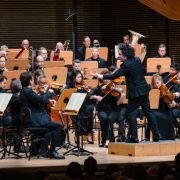
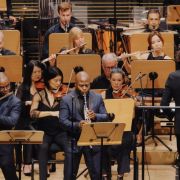
I’d have been curious to see where developing that impulse would have taken Reich, but the post-pandemic works on the program, Jacob’s Ladder (2023) and In All Your Ways (2026), drew from the same well as 2009’s Pulitzer-winning Double Sextet, all three performed by Ensemble Signal, conducted by Brad Lubman. And what a wondrous well it is. Pianos and vibraphones provided that motoric pulse, but now in constantly shifting meters, somehow both baffling and incredibly satisfying to the ear. Flutes, clarinets and non-vibrato strings soared above the pulse in dissonant drones and fleeting melodic fragments. This is music that sweeps you along in its wake, never predictable yet always coherent.


Double Sextet took a bit to settle into sounding balanced in the space, and the ferociously difficult task of tuning those dissonant long tones with the strings playing non-vibrato was not always entirely successful. Still, hearing this piece performed live you can’t help but marvel at the ridiculous levels of concentration required to perform a piece in which the meter changes every bar for two-thirds of the thousand-plus measures.
Jacob’s Ladder added four vocalists to the ensemble, who shared the drone and melodic materials with the winds and strings. Inspired by the Bible story, it began with playful motivic depictions of angels climbing and descending the titular ladder. but eventually developed a spiritual affect, culminating in an aching vocal melody over an instrumental ostinato.

And finally in In All Your Ways the two vibraphonists were joined by two marimba players, an unexpectedly shocking sound at the end of the evening. The melodic fragments expanded into elegiac run-on melodies, still over that ever-changing motoric pulse. This and Jacob’s Ladder both have a quiet emotional richness, not worn on the sleeve but gradually revealed as the pieces progress, an unobtrusive joy – in its own way just as much of a gift as the new vocabularies Reich gave us.