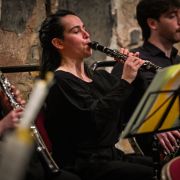
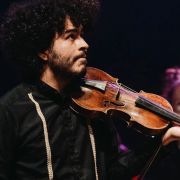
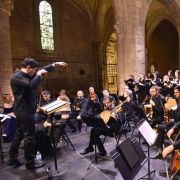
In this article series, together with Sustainable EEEMERGING and its partners, we explore Early music across Europe – and the challenges faced by young artists in various countries across the continent. What is the condition of Early music today?
This article was supported by All’improvviso Festival Gliwice.
Until the end of the 18th century, at the crossroads of Central and Eastern Europe lay one of history’s most extraordinary states: the Polish-Lithuanian Commonwealth. At its peak, a population of 12 million stretched across a vast tract of more than a million square kilometres, the largest country in Europe. Its cities and courts recruited musicians from across the continent, attracting an influx of artists and musicians, mixing musical styles of Germany, Italy, France and the Low Countries in Poland.

While the culture at the time was rich, even in Poland today there is much still to be researched and recovered. One group recently embarking on this is the Cohaere Ensemble, a young ensemble formed in Katowice in 2019. I talk with harpsichordist Natalia Olczak about their historical investigations into Baroque music in 17th and 18th-century Danzig (or Gdańsk), one of the wealthiest and most cosmopolitan cities in Europe.
“We found a few composers!” Olczak tells me. “Johann Valentin Meder, Nathanael Schnittelbach, Johann Gottlieb Goldberg – as you can see, very Polish names!” she jokes. As the Polish state’s principal sea port and a city of the old Hanseatic League, Danzig was close with other cities along the Baltic coast, including Prussia (who eventually annexed it in 1793). “At the time in Poland, we were paying musicians from abroad to come and play in our castles,” Olczak says. “Meanwhile, our people were fighting.” Yet despite the almost unending military turmoil the Commonwealth faced through its history, all the composers she mentions were born in Danzig – indeed, harpsichordist and composer Goldberg is the namesake of JS Bach’s famous Goldberg Variations.


As a harpsichordist who grew up in Poland, I’m curious about her early experiences. “I’m from a really small village in the south of Poland, where we didn’t have any Early music. We almost had no music at all – we had only one primary music school. I first heard about the harpsichord when I started to study in high school in Wrocław, a bigger city. I was studying piano at that time, aged about 13. It’s not super common for other Baroque or historical musicians in Poland, but in music history class, I heard the modern harpsichord used in Gorecki’s Concerto. I thought: Oh, this is a strange instrument! I don’t feel comfortable with piano, let’s switch!”
Olczak realised quickly that it was possible to get happily busy playing chamber music as a harpsichordist. “I was pretty active as a teenager, doing competitions – this is what musicians in Poland still do. More or less the ‘East’ way of showing that you’re good! We were also organising chamber music – before I turned 18 I had already played in two or three ensembles. In school, everybody wanted to play some random Baroque pieces, to have fun. I was really free to do whatever I wanted.”
Poland remaining a regular port of call for itinerant European musicians certainly seems to have helped. “Polish ensembles and orchestras were playing, but people from abroad were coming to Poland too. I heard Pierre Hantaï when I was 16 in the National Forum of Music, Wrocław. Jean Rondeau came to Gdańsk for the Goldberg Festival… Attending all these places, I felt super comfortable that I was doing such a strange thing, playing the harpsichord.”

Now teaching harpsichord as well as performing, Olczak is happy to be able to pass on her experiences of the instrument. “The moment you touch the key, you can feel the plectrum is on the string – and in one moment when you press the key just a little harder, it will immediately pluck it. It’s fascinating… I’m experiencing the harpsichord over again, understanding how it feels to play it.”
“I was really determined to go to the Karol Szymanowski Academy of Music in Katowice,” she says, “because I was never super interested in solo playing, being more drawn to chamber music and orchestra. I knew many musicians from there, and I thought something must be clicking there.” With an emphasis on practical education, the Szymanowski Academy was a crucial hub for meeting and joining with other players. But with less emphasis on theory and history, “I felt a rush to get some more knowledge,” Olczak says. “I decided to try to go to Schola Cantorum Basiliensis.”
But after a period in the heady atmosphere of Basel’s Schola Cantorum, returning to Poland allowed greater freedom, and in Katowice, Olczak and fellow musicians Monika Hartmann (violin) and Marta Korbel (cello) founded Cohaere Ensemble. In the midst of the pandemic, they spent time investigating Telemann, who himself was in Poland in the early 18th century. French music too, including Couperin, which eventually led to Pierre Gaultier de Marseille, whose Symphonies divisées par suites de ton formed the ensemble’s first album, recorded in collaboration with Ambronay.
Indeed 2025 has been a bumper year for the ensemble, with three recordings in the can, each requiring considerable research work. As well as Pierre Gaultier, the group was assembling their Gdański Barok Kameralnie (‘Danzig Chamber Baroque’) project. Italian music too: “We also recorded a really cute trio, Tessarini’s Il piacere delle Dame (‘The pleasure of the ladies’), and Valentini’s Allettamenti, which are pieces about the emotions – from a very Italian point of view.” As the 17th- and 18th-century Polish courts were bustling with Italian kapellmeisters, this repertoire might well have found its way to Danzig too.
We reflect on the wider situation for young freelancers working in Early music in Poland. “There are a few ensembles supported by government funding – including Capella Cracoviensis, Warsaw Chamber Opera and the Polish Royal Opera in Warsaw, and there is also Wrocław Baroque Orchestra. Some of them offer stable jobs, others comprise freelancers. It’s quite common that we are mixing everywhere,” Olczak says. “I think possibilities for freelancers are growing. There are small ensembles and orchestras which are applying for grants and organising their own festivals.”


To get a broader picture of the scene in Poland, I speak with Artur Malke, director of the All’improvviso Festival Gliwice and a board member of REMA European Early Music Network. “The first Polish Early music ensemble was established already in 60s,” Malke tells me, “Musicae Antiquae Collegium Varsoviense, which still exists as part of Warsaw Chamber Opera.” While there were developments in the next few decades, “they remained very limited due to the geopolitical situation; this changed in the 90s. One of the ensembles which became then the pioneers of historically-informed performance in Poland, who continue to be visible also on the international scene, was the Arte dei Suonatori orchestra.”
“In the last 10 years, we have noticed a significant increase in Early music artists establishing ensembles,” Malke says. “Nevertheless, there’s still a lot to do to bring Polish artists to the international music scene. The festival scene looks much better – festivals such as Wratislavia Cantans in Wrocław, Misteria Paschalia in Krakow, Actus Humanus in Gdańsk, Bach Festival in Świdnica, as well as our All’improvviso Festival Gliwice.”
Celebrating its 20th edition in 2027, the All’improvviso Festival now has concerts year-round. Focusing on Early music presented in new contexts, the festival has “a special attitude to improvisation, one of the roots of Early music, which lets us build bridges between other genres like jazz or world music.” Meanwhile, new concert halls have opened in recent years, including NOSPR Katowice Concert Hall, the National Forum of Music in Wrocław – and the Krakow Music Centre is coming soon, as well as a new concert hall in Warsaw. “I do believe that this kind of investment will influence the growth of the audience for classical and Early music in Poland. From the organiser’s perspective, I see that we still have a lot to do,” Malke says.
“Polish artists are currently in most of the top European ensembles,” Malke concludes, “bringing their top quality, gained through the very good music education in Poland.” Olczak concurs, saying that “in general, ear training, history of music, some theoretical subjects, harmony – they are at a good level for kids and high school students.”
Olczak continues to work regularly with young musicians, and the Cohaere Ensemble’s residencies as part of Ambronay’s EEEMERGING scheme were also enlightening in this regard. In Spain, Olczak tells me, “we were able to perform for blind kids and kids who were hearing impaired. It was a huge challenge figuring out how to create a concert, so that kids could have fun and feel something. I have the best memories of that.”
For the future, Olczak hopes that public funders in Poland continue to see the value in Early music and musical research. “I hope that government will not decide that we don’t need funding for festivals. I hope that we can find a way to reach younger people who aren’t always interested in music. I hope we can mix our music more with dance and different arts,” Olczak says. “And I also hope that Polish musicians can be more recognised outside of Poland – that we will build bigger bridges to play abroad. It’s all about connecting.”
See upcoming events in Poland.
Sustainable EEEMERGING is funded by the European Union.
Views and opinions expressed are however those of the author(s) only and do not necessarily reflect those of the European Union. Neither the European Union nor the granting authority can be held responsible for them.
This article was sponsored by Centre culturel de rencontre d’Ambronay.