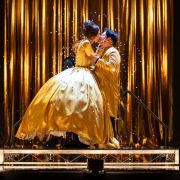
The latest iteration of Rossini’s La Cenerentola comes to Adelaide in a new State Opera South Australia production by Neil Armfield, which frames it within a stage production – a meta-production, as it were. With no drop curtain in place, the stage features a large metal scaffolding arch in the centre and a barrier fence across the front. A stagehand wanders on and gives everything the once over; this turned out to be Alidoro, managing the production as he manages the lives of the characters. A young woman comes on with an industrial sized broom as the overture strikes up, then wheels on a tea trolley, finally sitting down to darn socks. Meanwhile, more stagehands (= chorus) erect a purple curtain in the arch and remove the fence. The stepsisters enter from either side, with clothes racks attached to dressing tables. Thus events proceed in this ‘we’re-putting-on-a-show’ fashion, until the very end when a large gold drop curtain rather uncertainly descends.

The style of the production is located somewhere in the 1970s, all “puffy sleeves and flared conviction” (programme notes), but it isn’t quite as extreme as I remember the actual 1970s as being. There are certainly flares, on Don Magnifico’s purple suit (after his first appearance in undies and a very short red dressing gown) and the stagehands, several with mullets, essay sleazy disco moves. In his princely disguise, Dandini sports a gold frock coat over his flares, and extravagant sideburns. The puffy sleeves feature on the sisters’ floral day dresses. Cenerentola herself mainly appears in a medium length black dress, not at all tattered, but sober by comparison with the others. At the ball, she rocks a full-skirted white gown (and veil), with a gold version for the finale.

Don Magnifico’s wine-imbibing scene, which is always fun but doesn’t add much to the narrative, is omitted. A couple of less common sections are retained: Clorinda’s aria “Sventurata” is no doubt included in honour of Helena Dix's appearance in the role. The small scene for Don Magnifico and the stepsisters which introduces Act 2 is also included, which does provide some useful information, in that Magnifico won’t acknowledge Angelina as his daughter because he has run through her inheritance.

Stuart Stratford conducted the Adelaide Symphony Orchestra in a very smooth rendition of the overture, keeping up an excellent pace throughout. The male members of the State Opera Chorus were well synchronised in their singing and entertaining in their daggy dancing. There were no weak links in the cast, vocally or dramatically, and all the ensemble numbers were tightly rendered.

In the title role, mezzo-soprano Anna Dowsley was a Cinderella who seemed from the start quite unbowed by the carryings-on of her step-relations, simply surviving by doing the best she could, and being a model of kindness and sincerity. She did almost qualify for Magnifico’s description of her as a bag of bones (“un vero sacco d’ossa)” when compared with her well-upholstered sisters, but looked resplendent at the end. Her singing seemed restrained at first, but bloomed as she went along. “Nacqui all’affano... Non piu mesta” was delivered with firm confidence, smooth legato and impressive coloratura. Don Ramiro was sung by South Korean tenor Jihoon Son with a very fine lyric tenor, delivering a ringing rendition of “Si, ritrovaria io giuro”. Nicholas Lester was his Dandini, and his being a head taller than the prince lent some credibility to the pretence as far as the silly sisters were concerned.

I have not previously seen Teddy Tahu Rhodes in a comic role; he carried it off very well as Don Magnifico, including the more malevolent moments and the subsequent grovelling when all was sorted. His rich resonant bass lent further depth to the part. The stepsisters were suitably silly, with soprano Dix in a Dawn French wig, her powerful soprano soaring over all in the ensemble pieces. As Tisbe, mezzo-soprano Indyana Schneider had less chance to shine, but performed well. Bass Pelham Andrews is a popular Adelaide regular, and as Alidoro – stage hand, beggar in an especially ratty wig, wise tutor to the prince and deus ex machina – was something of a linchpin for the production.