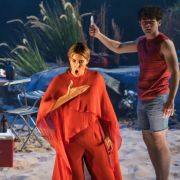
Il primo omicidio (The First Murder) is an oratorio composed by Alessandro Scarlatti to a libretto by Cardinal Ottoboni for performance in Venice in 1707, presented here in a fully staged production by Pinchgut Opera at the Roslyn Packer Theatre. This venue has the advantage over the City Recital Hall, which has seen many of Pinchgut’s previous productions, of being a fully functional theatre rather than a recital hall, with a proper proscenium arch, drop curtain, wings and so on. This production makes the most of those properties in fleshing out Scarlatti’s work, but it does raise the somewhat perennial question of why make that effort – dramatising an oratorio – when there are so many actual Baroque operas we haven’t seen here.

Director Dean Bryant elects to set the familiar story of Cain and Abel in a domestic frame, specifically, an Australian beach setting: Mum, Dad, two kids, an esky, a barbecue within a circle of sand with some rocky outcrops. In early 18th-century Italy, it is likely that all the singers would have been men, with the alto and soprano roles being allocated to castrati (given the trouble Handel got into at pretty much the same time for featuring Marguerita Durastanti as Mary Magdalene in La Resurrezione). For this production, the two leading roles are sung by women (soprano and alto) but they are portrayed dramatically by two young boys. This is actually all rather less buffo than it might sound, and is managed without the awkwardness that can sometimes ensue with this sort of arrangement.

Depicting a visualised God would definitely not have gone down well in the original context – in the score it is “Voce di Dio”, which would probably have come from off stage. Here, a female God in a long white gown stands to one side of the stage while appearing magnified on a video screen in the centre. Lucifer is similarly manifested within swirling flames. One small but rather distracting quibble: the Bible is very definite about Abel being a pastoralist, with herds of livestock and thus sacrificing a lamb, while Cain is a farmer, offering “the fruit of the ground” as his sacrifice (there are arguably good historical reasons for this differentiation). Why then do we seem him proffering a fish?
Musically, the performance was up to Pinchgut’s usual standard of excellence. An appropriately chamber-sized version of the Orchestra of the Antipodes was led by Erin Helyard, with concertmaster Matthew Greco leading off with the solo violin opening. The continuo group was particularly sumptuous, with Helyard oscillating between harpsichord and regal plus a chamber organ (Liam Green), theorbo (Simon Martyn-Ellis) and a delightful harp played by Hannah Lane. Despite the lack of any wind instruments, Helyard drew a range of tone and colour from the group.

The vocal cast was equally superb. Abel was sung by New Zealand soprano Madison Nonoa with warm well-projected tone, well matched with the creamy mezzo tones of Ashlyn Timms as brother Cain. Their acting counterparts, Ty Arnott and Ewan Herman respectively, were dramatically convincing as the young men. Eve was sung by soprano Sara Macliver whose Baroque chops are well known, with her trademark purity of tone and immaculate accuracy and control. She was also well paired with Kyle Stegall as Adam, probably better known in Australia in more purely operatic roles, singing here with well placed tenor focus and dramatic effect. Lucifero was sung by an alarmingly youthful looking Freddy Shaw who produced a most convincingly resonant bass-baritone sound, and appeared to relish his part. The role of God (a daunting assumption, one might imagine) was taken by mezzo-soprano Stephanie Dillon, who impressed as Cornelia in Pinchgut’s Giulio Cesare a few years ago, and managed to sound most authoritative as the divine voice.

If there is a problem in the production, it lies in the work itself: it is just not very dramatic. The high point of the drama – the eponymous murder – happens in the middle, so the second half is almost all dénouement, taken up with explanation, remorse and sorrow. There is a certain monotony in Scarlatti’s score, comprising a series of da capo arias, a few duets and no other vocal ensembles, with nearly every aria marked Andante or Adagio. There are hardly any surprises in the plot (Sunday School 101), and it is really a contemplative work, without anything like the excitement of the aforementioned La Resurrezione, for instance. Which brings us back to the issue of staging oratorios, admittedly something with which Pinchgut has had considerable success, rather than any number of neglected works actually written to be staged.