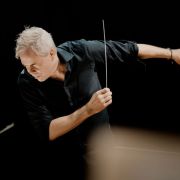
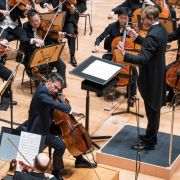
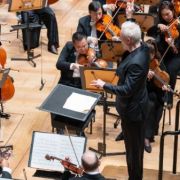
Pierre Bleuse returned to conduct the Singapore Symphony Orchestra and the decibel limit was again lifted. In 2024, Esplanade Concert Hall rocked with the racket that was Respighi’s Feste Romane, followed by Berlioz’s Symphonie fantastique last year. The ear-quake offered early here came via Prokofiev’s Scythian Suite, recycling music from his aborted ballet Ala et Lolli which had been rejected out of hand by Serge Diaghilev’s Ballet Russes. Inspired by Stravinsky’s The Rite of Spring, its primal violence was channelled through violent and clangorous ostinatos, reinforced by a battery of nine percussionists.

This is classical music’s heavy metal, foundry-forged without apology by Russian music’s enfant terrible before his escape from a collapsing Tsarist Russia to the West. Despite the dissonance, the music was never dodecaphonic, instead founded on established tonal centres which even possessed a modicum of tunefulness. This discord was highlighted with moments of tonal sensuality, muted strings floating over woodwind melodies and entreaties from both harps. Prokofiev was a Romantic at heart, but one covered from head to toe with spikes. Inducing the audience to applaud prematurely after the sonic orgy of The Evil God and Dance of Pagan Monsters, he was to influence modern film music more than given credit for.


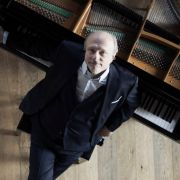
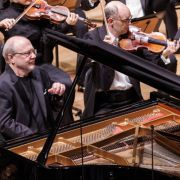
The orchestra responded with a heightened trenchancy, which continued into Liszt’s Piano Concerto no. 1 in E flat major, in support of French pianist Bertrand Chamayou. Launching with octave salvoes and blitzing the opening cadenza, Chamayou’s mastery was without doubt. His seemingly effortless pianism made one better appreciate Liszt’s genius in thematic metamorphoses and transformation. Like his Second Piano Concerto (which Chamayou performed here in 2016) or the B minor Sonata, simple motifs are developed which begin to seamlessly assume a life of their own. Piano trills leading to the third movement soon became one with Jonathan Fox’s solo triangle, a part so prominent that led critics to call it Liszt’s “triangle concerto”. The work’s breathlessly virtuosic close was driven with such élan and scintillation that Chamayou had to calm things down in his encore, Ravel’s Pavane pour une infante defunte, delivered with crystalline beauty.

That itself was a knowing nod to the concert’s second half, with Ravel’s popular orchestration of Mussorgsky’s Pictures at an Exhibition. For many, the original suite for piano suffers from monochromatic writing, something which Ravel gloriously transformed into a concerto for orchestra of sorts. Jon Paul Dante’s solo trumpet led in the opening Promenade, answered by the brass in full voice. Orchestral effects abounded, such as mysterious string glissandi in the awkwardly angular Gnomus, but none came as poetic as the scoring of Samuel Phua’s alto saxophone in The Old Castle. Tomoki Natsume’s tuba had its work cut out in the lumbering ox-cart Bydło, but it was Dante who starred again as Schmüyle, the second of the two Polish Jews, with his repeated-note bleating.


In a work with many highlights, the chirpy Ballet of the Unhatched Chicks and frenetic Marketplace in Limoges stood out, but it was the concluding Baba-Yaga’s Hut and The Great Gate of Kiev, with chiming tubular bells, which closed the evening on an ear-shattering high. With this very loud and sonorous close, Bleuse and company again blew the audience away, reciprocated with an equally raucous response.