With the right musicians, in the right room, listening to Julius Eastman’s 1974 composition Femenine can be something of a psychedelic experience. That and the 1973 work Stay On It are two of the most immediately appealing works in his catalog (sadly cut short with his death at 49 in 1990), bringing a sense of populism to his experiments in minimalism. There’s a looseness that lies not just in the score but in the spirit of the composer. Femenine was written around the time of Steve Reich’s Drumming and Clapping Music and Philip Glass’ Music with Changing Parts and Music in 12 Parts, but it carries the openness of jazz and the joy of rhythm and blues within the strictures of its approach and development.


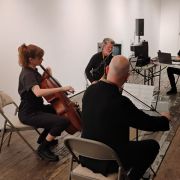
On 4th February, the right musicians were members of the St Luke’s Chamber Ensemble joined by soprano Ariadne Greif and the right room was the acoustically pristine Cary Hall at The DiMenna Center for Classical Music in Manhattan’s Hell’s Kitchen. The most surprising choice in OSL’s rendition was the addition of voice. The piece doesn’t have fixed instrumentation but isn’t scored for a vocal part. The decision to include the pitch perfect warmth of Greif certainly wasn’t a bad one, though. Where Stay On It has a recurring vocal line (repeating the title), the main motive in Femenine is a vibraphone ostinato paired with the mechanical shaking of sleigh bells. Greif largely followed the instrumental parts, seeming most often to melt in with the violin or accentuate the piano.
The sleigh bell mechanism that punctuates Femenine beginning to end was set up 15 minutes before the performance began, establishing the ethos of repetition and happenstance under the audience chatter. The bells can't rattle the same way twice; it's a steady rhythm but each beat falls differently. The musicians came and went, tuning and talking to one another, furthering the feeling of looseness. At some length, the lights dimmed and Maya Gunji introduced the vibraphone figure that would tether her for the next 75 minutes. Complementary lines were introduced as the music swelled across the sextet. Pianist Margaret Kampmeier soon reconfigured the repetitions with broken phrases and abrupt chordal statements. Throughout the performance, her attacks defined the sound space and established the piano as the guiding force. Eastman would go on to write works for multiple pianos (or which are commonly presented that way), but even in this relatively early piece, the piano is a beacon.


At about 30 minutes in, the introduction of a strong counterpoint – played here on saxophone (Lino Gomez) and horn (Priscilla Rinehart) – suggested a cerebral swing and an entirely new dimension. From there, the music blossomed. It kaleidoscoped. It fractalized. The akimbo vibraphone persisted but but as an anchor, it drifted and pulled at the line. The 13-beat phrase is easily learned, less easily repeated, the quick succession not evenly divided into threes or fours. It continued to swirl and I swirled with it until the music withdrew into gentle piano, then just the vibes, reducing to eight iterations of the repeating line, bringing it at last into something of a four count, and then the bells alone, threatening to go on forever.
I've heard Femenine performed several times and I have several recordings of it (including Eastman’s own). What stands out from one reading to the next isn’t the vibes and bells, it isn't the progression and variation, it's the personality of the players, the spirit of the ensemble. This is where Eastman’s music stands apart. It's minimalism with a beating heart.