These are dramatic, turbulent times and Eugene Onegin was a deliciously cathartic story and ballet to delve into on a cold January night at San Francisco’s War Memorial Opera House. But the imperative in these troubled times to draw a newfound order amid seemingly outdated tradition applies to ballet too, in the need to nudge the art form forward and expand what narrative ballet can be. In this, Yuri Possokhov’s reimagining of the classic based on Alexander Pushkin’s iconic 19th-century novel, succeeds in a masterful season opener and world premiere for the San Francisco Ballet last Friday night.

A co-commission with The Joffrey Ballet, Eugene Onegin bears Possokhov’s distinctive brand as acclaimed choreographer-in-residence for the San Francisco Ballet (which includes Swimmer, The Rite of Spring, RAkU). For this new production, he’s retained the sweeping romance and brooding drama of John Cranko’s renowned 1965 ballet and imbued it with contemporary flourishes that make the production seem fresh yet still classic.


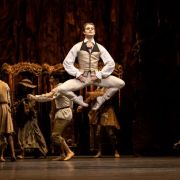
The story centers on a quartet of characters. Onegin (Joseph Walsh ) is a cynical aristocrat who has come with his friend, Lensky (Wei Wang), to visit Olga (Wona Park), Lensky’s fiancée. The vivacious Olga’s bookish older sister, Tatiana (Katherine Barkman), quickly falls for the disinterested Onegin, going so far as to pen him a love letter that night. All four leads danced superbly on Friday night.

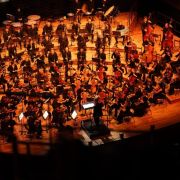
Martin West led the San Francisco Ballet Orchestra through a gorgeous commissioned score by Ilya Demutsky steeped in classicism while incorporating the contemporary, a bit of jazz here, some Broadway bravado there. This worked particularly well in Possokhov’s use of the changing seasons as a narrative thread, where four groups of ensemble dancing (Nikisha Fogo, embodying the exuberant spirit of spring, was a standout) mirrored the characters’ own evolution from youthful naiveté, impulsiveness, loss, regret and ultimately a somber self-awareness.
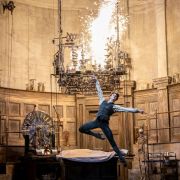
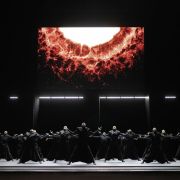
Another moment from Pushkin's original that Possokhov chose to highlight in his production was the opening scene where Onegin mourns at the funeral of an uncle whose property he will inherit. It’s a glimpse into the character’s emotional complexity as Onegin explores his feelings in an impassioned solo, which later makes his arrogance more tolerable. Fascinating too were the other mourners, huddled in semidarkness, who began to shake and contort in choreography so weird and intriguing that it told me we were in for something original from Possokhov.

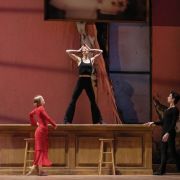
Costumes by Academy Award-winner Tim Yip (Crouching Tiger, Hidden Dragon) provided eye-candy attire for the seasonal ensembles. Tom Pye’s scenic designs, although minimalist (too much so?) have remained faithful to the novel’s 19th-century aristocratic setting. Jim French’s lighting design and projections by Finn Ross enhanced the mood, and the use of Pushkin’s own verses, superimposed on a black scrim (voiceover by Alex Jennings) was highly effective.


Possokhov has shared how he admires and embraces Pushkin’s poetic, often surreal storytelling of the human experience in unexpected and whimsical ways. An example of this appears when Tatiana has a feverish nightmare and from her mirrored armoire come a parade of eerily charming characters with animal heads, reminiscent of Christopher Wheeldon’s Cinderella. Onegin appears, sporting a bear’s head. Few dancers can match Walsh’s sublime acting skills, his ability to depict menace, cynicism, restlessness and impatience with sensitive types like the lovestruck Tatiana, all while wearing a bear’s head.
A misplaced flirtation sets the characters and story on a course for disaster that brings loss and devastating grief to the sisters. The final act, taking place several years later, is sobering yet satisfying – because who can’t be glad for Tatiana, who now rebuffs a returned Onegin after having found her prince (literally, in her case)? Nonetheless, a final pas de deux between a newly smitten Onegin and Tatiana holds tremendous “what if?” power, both characters throwing caution to the wind, physically as well as emotionally, for several euphoric minutes.

Walsh and Barkman were at their finest, with the overhead lifts, turns and whirling around in a dizzying flurry of movement. When Tatiana ultimately leaves Onegin, winter takes over as the crimson drapes lining the walls begin to blow with the wind before dropping like leaves. The end, a final image of Onegin in his aloneness amid falling snow and piles of crimson, delivers a vivid, cinematic conclusion to a stellar production.