Mark-Anthony Turnage’s Three Screaming Popes began when, the composer recalls, he went to see an exhibition of Francis Bacon’s paintings at the Tate Gallery in 1985. “I was particularly taken with the three Pope paintings, based on Velázquez’s Pope Innocent X, and my initial idea was to write a piece which distorted a set of Spanish dances as Bacon had distorted and restated the Velázquez.” This process was abandoned for a different approach, and Turnage hoped nonetheless that what “comes across is the coloristic intensity and emotional immediacy of the paintings.” He need not have worried.

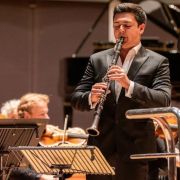
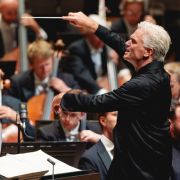
The works was commissioned for the CBSO and Simon Rattle, and was premiered by them at Birmingham’s Symphony Hall with some success in 1989. Unlike many another piece which made an impact at its premiere, it has not left the repertoire since. It has a lot to say in just 15 minutes, with only a little orchestral screaming included, and plenty of development and a sense of both variety and continuity. The London Philharmonic Orchestra under Principal Conductor Edward Gardner played it expertly with the woodwinds and brass delivering that coloristic intensity Turnage hoped would come across. The composer, in his trademark headgear, was warmly received as he took his bow.


The first of Bartók’s two violin concertos (1907-08 ) reflects the composer’s obsession with the brilliant and beautiful violinist Stefi Geyer, of whom it is a portrait. The first of its two movements displays “the idealised Stefi Geyer, celestial and inward” while the second shows “the witty and entertaining” aspect of her personality. But soon after the work was finished, Geyer ended their relationship. A broken-hearted Bartók still sent her the manuscript of the concerto, which she never played. Depending who you read, Bartók chose not to promote the concerto thereafter, or simply failed in his attempts to interest any other performer in it. But either way the effect was the same, for it was first performed only in 1958, after both Geyer and Bartók were dead.
If one heard the work not knowing its author, surely few would identify him correctly. Written before his folksong researches had begun to influence his own works, there is little of the mature Bartók sound. But it is quite agreeable enough to be worth an occasional hearing, and a soloist of Alina Ibragimova’s calibre would not learn a work she did not value. On this evidence she clearly believes in every note, and almost persuaded us to do so. Her sweet-toned lyricism was no less impressive than her dazzling bravura passages, and the LPO gave strong support.
After a first half devoted to Papal paintings and an artist’s portrait – or screaming popes and shattered hopes – what could follow but Mussorgsky’s Pictures at an Exhibition? Ravel’s orchestral version of 1922 is so vivid the work almost becomes one of joint authorship. Mussorgsky was a friend of the painter Victor Hartmann, who died young. Pictures at an Exhibition is a memorial tribute to him, musical impressions of his paintings, linked by a series of ‘Promenades’, or walks around the gallery. The grotesques among the ten pictures were the most striking here. Gnomus and later The Hut on Hen’s Legs, wherein dwells the Russian witch Baba-Yaga. Her music is summarily severed by the brass chords of the finale, depicting‘ The Great Gate of Kiev. Hartmann’s design for this triumphal gateway in the Ukrainian capital was never built, but few physical structures could be as imposing as the one Mussorgsky created in his music. Few concerts close with such a grandiose statement, nobly sustained by Gardner and the LPO.